(u.osu.edu)
The court date is Dec 15 for Guan Heng who is being held in Binghamton, New York, despite a pending asylum claim. I’m horrified that the US seems to have completely abandoned human rights and might actually hand this man to torture and death by the Chinese Communist authorities? Sincerely, Magnus Fiskesjö <nf42@cornell.edu>
Source: Human Rights in China (12/12/25)
Man who filmed Uyghur concentration camps now fights for his own freedom in the United States
“If he gets sent back, he’s really dead,” Guan Heng’s mother said. His fate hangs in the balance as he awaits his scheduled court appearance in New York on December 15th.
By Lu Jingwei (Atlas Luk)
Editor | Qiu Li
This post was originally written in Chinese: 中文版
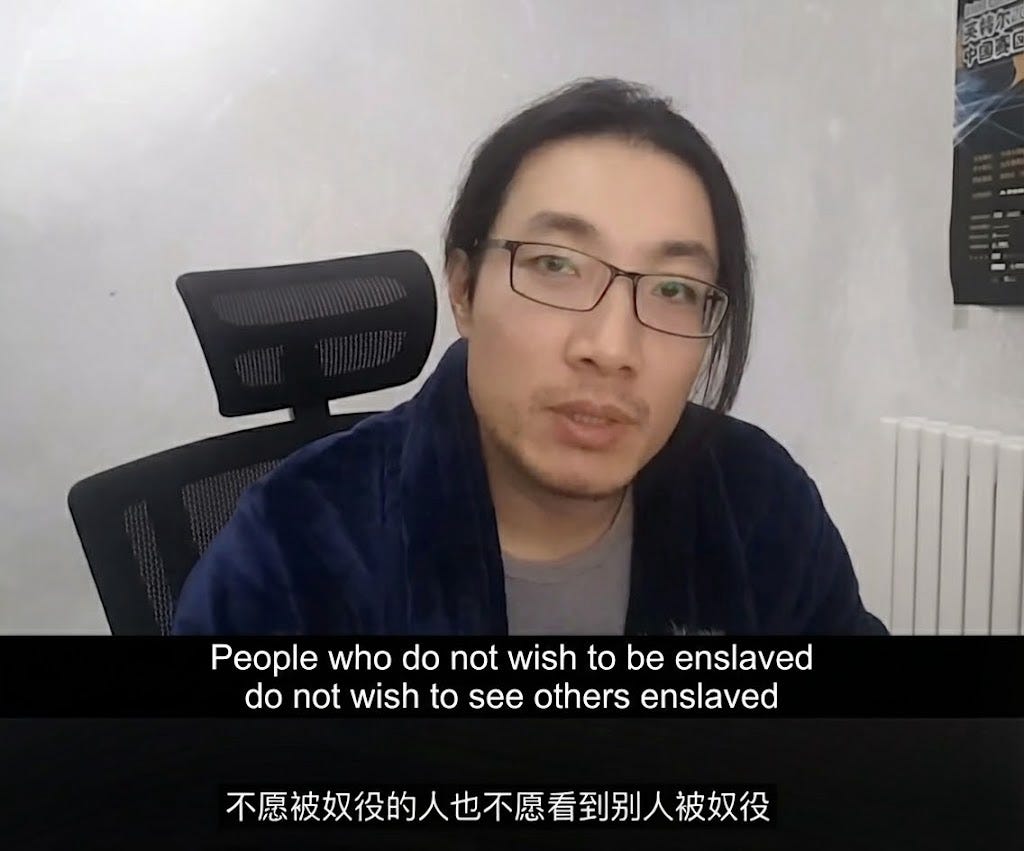
Screencap of the video documenting Uyghur concentration camps released by Guan Heng.
This is a story of courage, escape, and absurd paradox.
In October 2020, Guan Heng, a young man from Henan, China, drove alone into Xinjiang, using a telephoto lens to document the concentration camp facilities hidden in the wilderness, towns, and military camps. To make these images public, he embarked on a thrilling escape: he made his way through South America and finally sailed alone in a small boat for 23 hours from the Bahamas, successfully landing in Florida. After arriving in the United States in 2021, he released the videos as planned. This footage became crucial evidence for the international community (including BuzzFeed News’ Pulitzer Prize-winning team) to confirm what China was doing in Xinjiang.
Four years later, Guan Heng, who had once thought he was safe, lost his freedom in the United States. In August 2025, during a raid by U.S. Immigration and Customs Enforcement (ICE) on Guan Heng’s roommate, Guan Heng was arrested in upstate New York for “illegal entry.” Now, he is in the Broome County Correctional Facility in New York State, facing the threat of deportation—being forced to return to the China he risked everything to escape.
On the morning of August 21, 2025, in a residential area in upstate New York, Guan Heng was awakened by a violent knocking on his door. It was ICE agents.
They weren’t there to arrest him. Their target was Guan Heng’s roommates—a couple who ran a local business buying and selling storefronts. They had been reported over a financial dispute with someone else. But when the ICE agents burst into the house with a search warrant, 38-year-old Guan Heng was there by chance and was subsequently arrested. The following conversation ensued:
Agent: “How did you enter the country?”
Guan Heng: “I came by sailing a boat over the ocean.”
Agent: “Do you have an I-94 form (entry record)?”
Guan Heng: “No.”
Guan Heng was first taken to an ICE office, then transferred to a county jail near Albany, where he was held for a day, then transferred to an immigration detention center in Buffalo, where he was held for nearly a week. Finally, he was sent to his current place of detention—Broome County Jail.
“They don’t care whether I have a work permit or what the status of my asylum case is,” Guan Heng said in a phone interview with Human Rights in China in October 2025, his voice filled with confusion and frustration. “They only care about how I entered the country. They just said that I didn’t enter through normal customs, and that act itself is a crime.”
His asylum application, which had an interview pending, his valid work permit, his New York State driver’s license. . . in the eyes of ICE, all of these were worthless because he had “entered without inspection” by customs.
With the Trump administration cracking down on illegal immigration, Broome County Jail was overcrowded. Months passed, and Guan Heng waited anxiously and dejectedly for the outcome of his case. No one knew what this young man from China had gone through in the past few years; nor did anyone know that the images he had filmed of the Xinjiang detention camps, at great personal risk, provided crucial evidence of the Chinese authorities’ actions against the Uyghur people in Xinjiang. Or that if he were to be deported, he would be facing immense danger.
Guan Heng was born in November 1987 in Nanyang, Henan Province.
According to Guan Heng and his mother, Guan Heng grew up under the care of his grandmother because of his parents’ divorce. After his grandmother passed away, he lived alone. Before leaving China in July 2021, he had worked many different jobs—he opened a fast-food restaurant, worked in an oil field for a few years, and eventually became a freelancer. Guan Heng explained that he actually learned to bypass internet censorship (“climb over the Great Firewall”) quite early on.
Unlike many young Chinese people, Guan Heng’s “internet censorship circumvention” journey didn’t stop at entertainment like movies and music. Through the internet, he reached “forbidden zones” buried by official narratives, from the Great Famine of the 1960s to the Tiananmen Square massacre of 1989. This truthful information from the outside world had a profound impact on his thinking, and a crack opened in his heart.
“I came to understand little by little, and eventually discovered that the Chinese government had hidden so many unspeakable secrets,” Guan Heng said in November 2025, as he recalled his experiences during a phone interview from the detention center conducted by the author of this article. He said that by the time he graduated from university, he had become a silent dissident, someone living under the system but whose thoughts had already “escaped.”
In 2019, Guan Heng, an adventurous tourist, rode his motorcycle all the way from Shanghai to Xinjiang. He expected a scenic journey, but instead ran into an invisible wall of heavy-handed control.
“The feeling was so obvious,” he said. “As soon as I entered Xinjiang, there were numerous checkpoints, and police officers and armed police were everywhere. Just checking into a hotel required registering multiple times and using facial recognition.” At gas stations, he was even subjected to strict restrictions simply for riding a motorcycle. This trip to Xinjiang allowed him to witness firsthand the harsh social control system implemented by the Chinese government in Xinjiang, but at the time he still didn’t fully understand the extent of it.
In 2020, when the COVID-19 pandemic broke out, Guan Heng, like hundreds of millions of Chinese people, was confined to his home. During a moment of boredom while browsing the internet, he clicked on a report from well-known American online media outlet BuzzFeed News. The report, using satellite imagery and data, revealed a vast network of concentration camps spread throughout Xinjiang.
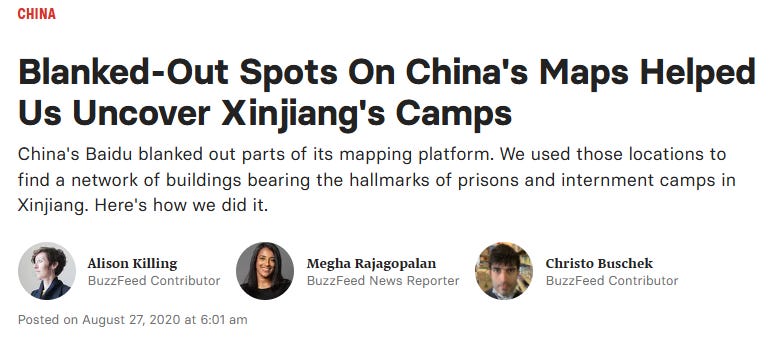
Screencap from one of BuzzFeed News’ Xinjiang series reports, published on August 27, 2020.
At that moment, the questions he had during his 2019 trip to Xinjiang were answered. He realized that the checkpoints, police, and facial recognition systems he had seen in Xinjiang were actually part of this vast social surveillance system.
“Based on my understanding of the Chinese government, they are very good at concealing things they don’t want people to see,” Guan Heng said. “This strongly piqued my interest, especially since I had been to Xinjiang but knew nothing about this. I really wanted to go back and see for myself what was going on.”
He knew very well that for an ordinary person on a tourist permit to do something like this would be tantamount to committing suicide. “I fully anticipated the risks,” he said calmly. He began preparing as if planning a secret operation: he didn’t use his professional equipment, but instead rented a long-range DV (digital video) camcorder online so that he could film from a safe distance.
He prepared two SD cards. After filling one card, he immediately hid it in a concealed corner of his car; the other, an empty, unimportant card, was inserted back into the DV camcorder. “I was afraid of being questioned,” he said. “At least they wouldn’t know what I had filmed.”
In October 2020, Guan Heng drove alone to that troubled region he had visited a year earlier—Xinjiang.
Guan Heng’s itinerary was not an aimless journey, but a “puzzle-solving” expedition guided by a map. That “map” consisted of the satellite coordinates of suspected “detention camps” marked in the BuzzFeed News report.
He spent three full days traversing the vast landscape of Xinjiang, verifying each coordinate point marked in the article as gray (low suspicion), yellow (medium suspicion), or red (high suspicion).
Guan Heng’s first location for observation was Hami City. Before he arrived in Hami City, he went to a place called “Beicun,” which had a gray marker (low suspicion). It was a pink house, without barbed wire or anything similar, and it seemed like there weren’t many people around, not like a detention facility.
Then, he drove into Hami city and found a yellow marker, a place with a sign that read “Hami City Compulsory Isolation and Rehabilitation Center.” It was located in a bustling area with heavy traffic, which made Guan Heng skeptical, as “a rehabilitation center in a busy city center is unlikely to be a detention camp.” But then, he found another yellow marker: “Xinjiang Production and Construction Corps 13th Division Detention Center.”
This place immediately put him on edge. Hidden at the end of a small alley, the detention center itself was surrounded by high walls, and several adjacent courtyards were similarly enclosed by high walls and barbed wire fences, clearly not ordinary residential areas. This perfectly matched the characteristics of the concentration camps described in the report.
To cover his tracks, when leaving, Guan Heng deliberately bought some snacks at a shop at the entrance of the alley and intentionally paid using WeChat Pay. “If I was questioned,” he explained afterward, “I would at least have a reason for being in that dead-end alley.”
The next day, Guan Heng kept moving on the highway. He passed through three counties: Mulei, Jimsar, and Fukang. He found many BuzzFeed markers, all pointing to existing “detention centers” or “prisons” in various locations—the Mulei County Detention Center, the Jimsar County Detention Center, and the Fukang City Detention Center. In Mulei County, he found two gray markers, a “farmer and herdsman training school” and a “vocational education center.” Although the buildings appeared abandoned, the barbed wire remaining atop the courtyard walls seemed to tell the story of their former purpose.
That day’s journey made him realize that the scale of this operation was far larger than he had imagined—the authorities were not only building new facilities, but also utilizing, modifying, and expanding existing detention systems.
However, this also made things trickier, because watchtowers and barbed wire fences are inherent features of detention centers generally, making it difficult to determine solely from the appearance of the facilities whether they were being used as internment camps for Uyghurs.
On the third day, Guan Heng drove through three cities: Urumqi, Dabancheng, and Korla. This was the most fruitful and also the most perilous day of his trip.
In the suburbs of Urumqi, he used coordinates to find the “Urumqi City Second Education and Rehabilitation Bureau (Drug Rehabilitation Center).” He parked his car some distance away, pretending to be a passerby out for a morning walk, and filmed with a GoPro camera as he went. He not only filmed the drug rehabilitation center but also discovered three equally heavily guarded compounds surrounding it. At the entrance of one facility, he filmed a vegetable delivery truck unloading goods—evidence that the facility was operational.
Immediately afterward, on the nearby “Gaoke Road,” he made his most crucial discovery of the trip. On one side of the road was a vast, sprawling complex of facilities, complete with high walls and watchtowers, but it was unmarked on any map. Guan Heng used his telephoto DV camera to zoom in and successfully filmed the prominent red lettering on top of the buildings: “Reform through labor, reform through culture” (laodong gaizao, wenhua gaizao).
That afternoon, he traveled to Dabancheng. This was a “red marker,” hidden deep in the wilderness far from any road, without even a gravel path. Guan Heng parked his car by a pond and climbed the steep hillside alone.
“At that time, I was incredibly nervous,” he recalled. He lay prone on the hillside, his camera focused on a brand-new, massive, but seemingly unused building complex. After filming, he hurried down the hill, only to break out in a cold sweat—he discovered there was a house on top of the hill he had climbed, and a man fishing by the pond where he had parked his car.
He feigned composure and proactively approached the man, striking up a conversation: “Sir, what are you fishing for?” Once he confirmed that the other man hadn’t noticed his suspicious behavior, he quickly drove away.
The final stop was Korla, 339 kilometers from Urumqi. There, the coordinates Guan Heng was looking for pointed to an area behind a military camp (with tanks at the entrance). It was a large, heavily guarded facility, and the only way in was through the military camp itself.
As Guan Heng attempted to drive his car off the shoulder of the road to get closer to the military camp for filming, a man from a shop next to the camp came out and stared at him intently.
Amid the tense atmosphere of this standoff, Guan Heng thought fast. He slammed on the accelerator and drove his high-chassis SUV, drifting and spinning in the wasteland, deliberately acting as if he were “testing the car’s performance” for fun. The “shop owner” seemed confused by this erratic driver, watched for a while, and then, bored, went back inside.
The moment the man turned away, Guan Heng stopped the car, took out his telephoto DV camera, and filmed the final scene for his video.
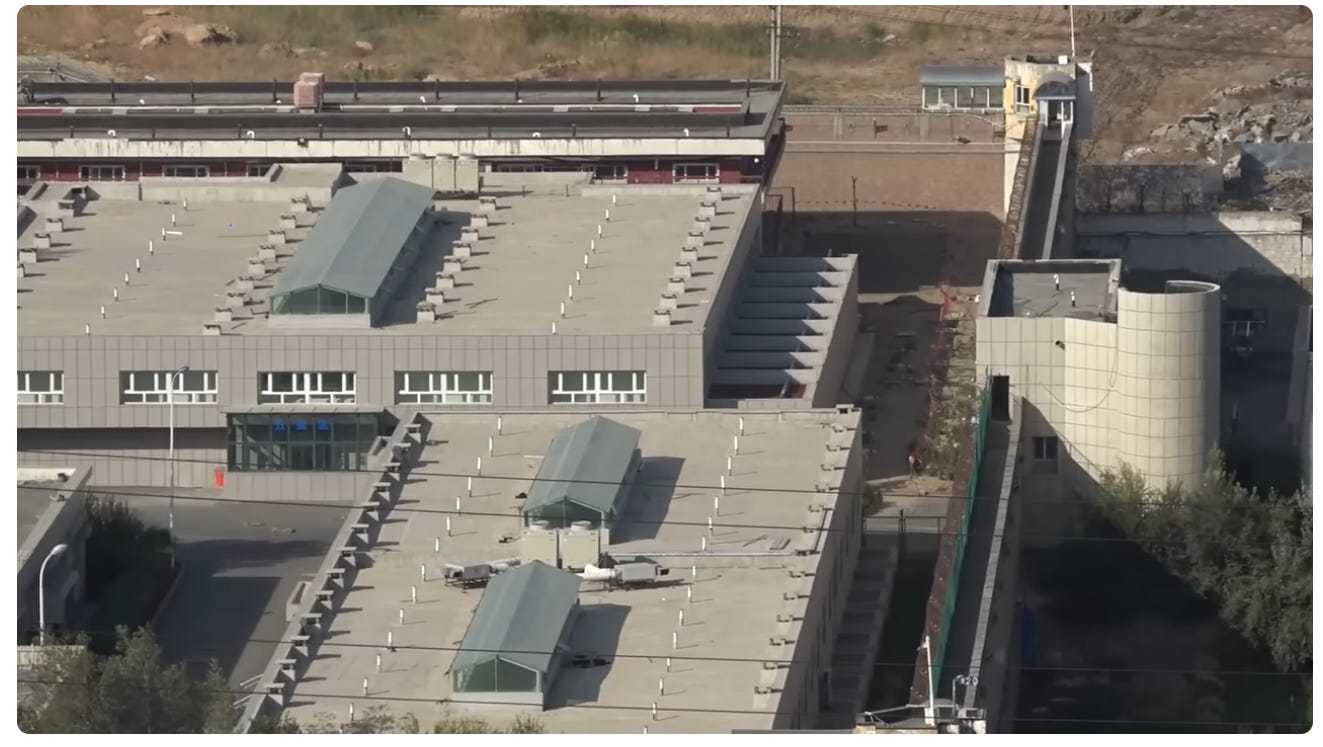
A screenshot from Guan Heng’s video.
The film was complete. Guan Heng was holding a “digital bomb,” but he quickly realized a fatal problem: he couldn’t press the “publish” button without blowing himself up.
“I knew that just finishing the film wasn’t a big deal, but once it was posted online, they (the police) would definitely find me,” Guan Heng said in the interview. “If I were apprehended, these videos would either not be released or would be deleted, and my life would be threatened.”
The only solution he could think of was to leave China.
But the fuse on this bomb was stretched incredibly long. Since the COVID-19 pandemic broke out in 2020, China’s borders had been closed. Guan Heng had nowhere to go and could only wait in depression and anxiety, holding onto these materials. It wasn’t until the summer of 2021 that a window of opportunity finally opened. On July 4th, he left China via Shekou, then took off from Hong Kong and flew to Ecuador, a South American country that offered visa-free entry to Chinese passport holders at the time.
He stayed in Ecuador for more than two months, for only one reason: to get the Pfizer vaccine. He couldn’t trust the vaccines produced in China, but at that time the domestic vaccination policies were becoming increasingly strict. “Without vaccination, your health code would turn red, making it impossible to travel anywhere.”
After receiving two doses of the vaccine, he flew to another visa-free country—the Bahamas. From there, his final destination was just a short distance across the water. He had initially planned to have a boat shipped from China to save money, but his Bahamian visa was only valid for a short time—he recalls that it was only 14 days—and the shipment was delayed. By October 2021, he couldn’t wait any longer. He had no choice but to spend almost all of his remaining money, nearly USD$3,000, at a local marine supply store to buy a small inflatable boat and an outboard motor. Then he set off from Freeport in the Bahamas, heading towards Florida in the United States. He saw on Google Maps that the straight-line distance across the sea was approximately 85 miles.
As Guan Heng explained, he had no sailing experience, didn’t know how to row a boat, and even suffered from severe seasickness. This was the first time he had ever driven a boat in his life. His only resources were a mechanical compass and a mobile phone with a GPS map.
“I drifted at sea for nearly 23 hours,” he recalled. He had brought plenty of food and water, but due to extreme anxiety, “I only drank one can of soda the entire time.” The biggest threat during the journey wasn’t the waves, but his makeshift engine.
“I didn’t have much money at the time, so I couldn’t buy a sealed fuel tank,” he said. “I had to carry a fuel can and repeatedly pour fuel directly into the engine on the violently rocking boat.” Gasoline spilled everywhere, and the entire boat was filled with a strong smell of gasoline, which could ignite at any time from a single spark.
“That boat became a floating bomb,” Guan Heng said. “I was truly terrified afterward, because if a fire had broken out, I wouldn’t have made it to the United States.”
He had planned to land at night to avoid detection. But during the endless drifting, his only thought was “get there quickly.”
Early the next morning, he spotted the Florida coastline in the distance. Around 9 a.m., the small boat reached the shore. There were already early-morning strollers on the beach, including an elderly couple walking towards him. Guan Heng’s heart pounded in his chest; he was afraid the couple would call the police.
He didn’t bother with the boat or the scattered luggage on board. Clutching only his most important backpack, the moment the small boat hit the shallows, he jumped out and ran towards the bushes on the shore. He hid in the bushes, gasping for breath. After a while, he saw a Coast Guard patrol boat sailing by offshore. But he was already safe.
In this way, through a covert path, Guan Heng arrived in the “free world” he had longed for.
According to Guan Heng, he had already scheduled a posting time for the video he had filmed before going into the water in the Bahamas. “I didn’t know if I could safely reach the United States,” he said. “I couldn’t wait until I arrived to release it.” On October 5, 2021, his video on the Xinjiang concentration camps was finally released to the public through his YouTube channel.
The video immediately caused a huge stir. As an extremely rare, first-person, on-the-ground video from a Chinese citizen, Guan Heng’s video was quickly reported on and cited by media outlets such as Deutsche Welle and Radio Free Asia. More importantly, it provided crucial on-the-ground evidence for BuzzFeed News’ Pulitzer Prize-winning team. BuzzFeed reporters, in interviews with Deutsche Welle and Radio Free Asia, specifically emphasized the extraordinary value of Guan Heng’s footage, praising the filmmaker’s courage and stating that the new information in the video confirmed their understanding of what was happening in Xinjiang.
At the same time, as the detonator of this information bomb, Guan Heng himself was subjected to immense pressure beyond his expectations—a massive attack targeting him personally, launched by Chinese state security and online propaganda entities, immediately began online.
Shortly after he released the video, a YouTube blogger named “Science Guy K-meter” posted a doxing video that exposed all of Guan Heng’s personal information, including his real name, date of birth, alma mater, and home address. This blogger, “Science Guy K-meter,” typically posts content with a pro-communist stance.
“They doxed Guan Heng,” said Ms. Luo, Guan Heng’s mother, in an interview with Human Rights in China on November 1, 2025. Her voice trembled slightly with anger. “The comments below were extremely vicious, calling Guan Heng a traitor, and saying, ‘It would be best if he were accidentally killed by a black man in the United States.’”
Meanwhile, a “siege” against his YouTube channel began. Guan Heng recalled in the interview: “They first reported it for a ‘privacy violation’ (the video showed a security guard), and YouTube took down my video.”
He was forced to appeal and used YouTube’s built-in tools to blur the image. After the video was restored and put back online, the other party realized this tactic was effective and began “frantically reporting” all of his videos. Guan Heng’s backend system was instantly overwhelmed with a massive number of “violation notices.”
This precise, state-sponsored online personal harassment and systematic technical attack psychologically devastated Guan Heng.
“I was under immense psychological pressure at the time,” Guan Heng recalled. “I basically stopped paying attention, deliberately avoiding looking at these things.” The relentless online harassment plunged him into severe depression. To protect himself, he deliberately cut off contact with information from the outside world. Because of this, he didn’t even know the enormous impact his videos had on the international community until he was arrested. He only knew that he was being systematically targeted by the authorities, and he was afraid.
He went into hiding. But the true epicenter of the storm erupted in his hometown of Nanyang, Henan.
According to Guan Heng and his mother, Ms. Luo, about a month after Guan Heng’s videos were released, in January 2022, a systematic “collective punishment” campaign targeting all his relatives, led by state security, began.
“When I returned from Taiwan (at the end of 2023), everyone (in my family) was very nervous,” Ms. Luo said. “They were very worried that I would be detained at the airport because they had already experienced being summoned for questioning.”
According to Ms. Luo, her four sisters, who live in her hometown in Henan province and the provincial capital Zhengzhou, were all summoned by local state security officials at around the same time. “The police told them,” Ms. Luo said, “that if they had any information about Guan Heng, they should report it immediately. They warned them that if they failed to report any information, you know what will happen then.”
In late January 2022, four police officers took Guan Heng’s father from his home for an interrogation that lasted from noon to 9 PM. The police confiscated his mobile phone on the spot, and took it to the Nanyang Municipal Public Security Bureau to recover the data. That evening, the police escorted his father to his grandmother’s house, where Guan Heng had lived before going abroad, seized the computer tower he had left behind in China, and issued a “seizure list.” More than a month later (March 2022), state security officials interrogated his father again.
State security personnel also located Guan Heng’s paternal aunt that he had been closest to since childhood. They took his aunt and uncle away separately, and interrogated them separately. This psychological warfare completely devastated Guan Heng’s aunt. “She (the aunt) is so scared now that she can’t sleep at night,” Ms. Luo said. “She later said something very harsh to him (Guan Heng’s father): ‘Please don’t come to me about Guan Heng’s matter anymore! Our family still has to live here, and I’m afraid it will affect my children, I’m afraid they will be implicated! Please don’t harass me anymore!’”
Guan Heng was unaware of all this at the time. While he thought he was alone in New York, silently processing the trauma of online harassment, his entire family back in China had been thoroughly “investigated” and “intimidated” by state security.
Thus, carrying the scars of trauma and a complete break with his homeland, Guan Heng lived alone in the United States for three years. Until the summer of 2025, when fate, in an even more absurd way, pushed him into another cage.
For more than three years in the United States, Guan Heng tried to rebuild his life in solitude. On October 25, 2021, he filed for asylum in New York, and subsequently obtained a work permit, bought a used car, and initially made a living in New York City by driving for Uber and delivering food. Later, he switched to being a long-haul truck driver, “because as a truck driver, I lived in the truck every day, so I didn’t need a place to live.” After quitting his job as a truck driver, he decided to move out of New York City.
“I especially liked the state parks upstate,” he said. Seeking a quieter environment closer to nature, in the spring of 2025, he moved from New York City to a small town near Albany.
He was just a tenant. He shared a house with a couple from China who were the “sub-landlords” of the property. This peaceful life continued until one morning in 2025, when the violent knocking of ICE officers shattered the peace.
At the time of his arrest by ICE, Guan Heng presented his work permit and asylum documents to prove his identity, but it seemed that, under the enforcement logic of ICE—an agency under the Department of Homeland Security (DHS)—Guan Heng’s status with the New York U.S. Citizenship and Immigration Services (USCIS) office was irrelevant.
Simply because he had entered the country by sea, Guan Heng was arrested as an “illegal immigrant.” He was first taken to the ICE office, then sent to a county jail near Albany for a day, transferred to an immigration detention center in Buffalo for nearly a week, and finally, he was sent to his current place of detention—Broome County Jail.
Initially, he was held in the immigration section. “It was okay there,” he said. “I was with immigrants from other countries; we were all in the same boat, had common topics, and could play ball and cards together. It was lively.”
But a month later, he was transferred to a section with only American inmates—many of whom, according to him, were sex offenders.
He once again found himself in complete isolation. “There’s nothing to talk about with them,” he said dejectedly over the phone. “The air in the common area is terrible; I cough constantly if I stay there too long, so most of the time I have to stay alone in the courtyard or in my own room.”
It was in this extreme solitude that he began to reflect on his life.
“While in here, I met a fellow inmate who was also an immigrant,” Guan Heng said. “They said something to me that deeply affected me. They said, ‘Two people are always better than one.’”
This struck him. “I was thinking at the time,” he reflected, “if I had family or friends with me, I might not have moved upstate, and I wouldn’t have been arrested. If I had someone by my side, my mental state would also have been much better.”
He realized that the “solitary courage” that allowed him to accomplish his feat in Xinjiang was also his Achilles’ heel.
“Before, I always thought I was a lone warrior, that I had to solve all problems myself,” he said. “But when I actually went to prison, I realized that no matter how strong my personal abilities were, I couldn’t do anything. I had to completely rely on outside help.”
Now, he has begun to realize that he must break free from his past mindset of deliberately going it alone and turn to American civil society and human rights organizations to prevent U.S. law enforcement agencies from deporting him back to China, the country whose dark secrets he risked his life to expose, and where the consequences of his return would be unimaginable.
While Guan Heng was detained in Broome County Jail, facing the immense risk of deportation, several letters of testimony were sent to his lawyer. These letters revealed a fact that Guan Heng himself was unaware of: the footage he had risked his life to film had become a crucial piece of the puzzle in the international community’s understanding of the human rights crisis in Xinjiang.
The first letter came from the source that had inspired him to embark on his journey. The Pulitzer Prize-winning BuzzFeed News team (Megha Rajagopalan, Alison Killing, and Christo Buschek), who had inspired Guan Heng to go to Xinjiang, wrote a joint letter of support for him after learning of his situation. In the letter, they confirmed that it was Guan Heng’s on-the-ground evidence that filled in the last missing piece of the puzzle in their satellite image analysis.
“Mr. Guan provided crucial corroborating evidence for our investigation at great personal risk. His courage is extraordinary. . . He had no other reasonable reason to be near many of these detention sites, as they are typically located in remote areas. . . If caught, the danger he faced would have increased significantly,” the BuzzFeed team wrote in the letter. They specifically pointed out that the evidence provided by Guan Heng helped confirm the existence of the new Dabancheng prison—directly exposing the Chinese government’s lie that the “re-education camps have been closed.”
The joint letter concluded: “We believe that if Mr. Guan is deported back to China, he will face great danger. Therefore, we call on the United States to grant Mr. Guan asylum and to end his detention and the threat of his deportation.”
The second letter came from Janice M. Englehart, the producer of the documentary “All Static & Noise.”
Guan Heng’s footage was included in this documentary, which reflected the living conditions of the Uyghur people. It has been screened in New Zealand, Australia, Japan, and the United Kingdom to expose the Chinese government’s abuses.
In her letter of support, Ms. Englehart stated: “Mr. Guan risked his own safety and that of his family to provide crucial video evidence, which, corroborated by satellite imagery, confirmed the existence of concentration camps operated by the Chinese government in the Xinjiang Uyghur Autonomous Region. . . His efforts in 2020 provided support to researchers, journalists, and documentary filmmakers, enabling them to confidently understand and disseminate information about what is happening in Xinjiang, a region of China that has long been inaccessible to many Western journalists, diplomats, and visitors.”
At the end of the letter, Ms. Englehart stated unequivocally: “Mr. Guan’s actions are entirely consistent with U.S. national interests.” She warned that if Guan Heng were repatriated, he would likely face torture or even death on charges of “espionage” or “colluding with foreign forces.”
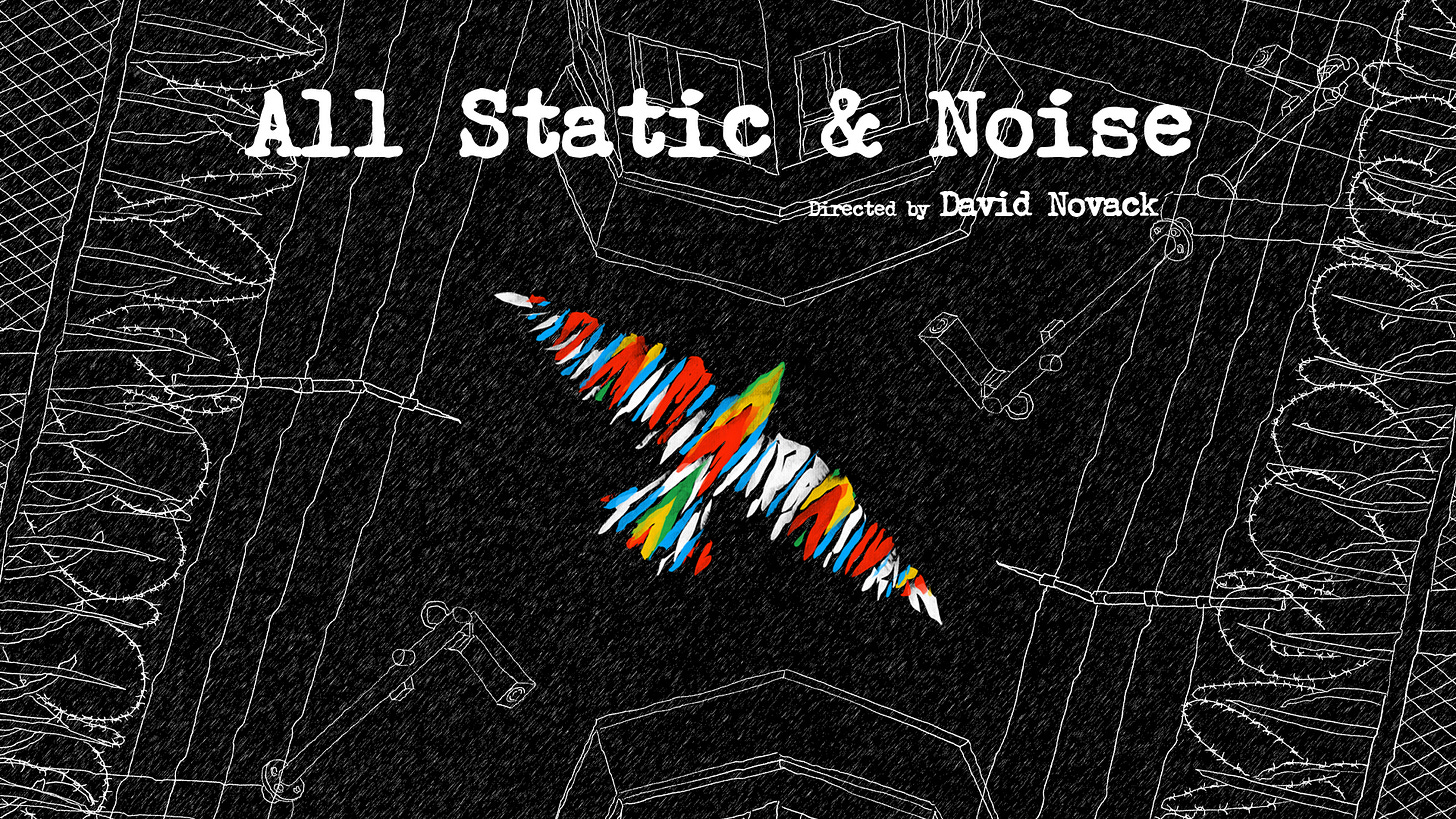
The cover of the documentary “All Static & Noise.”
Another testimony and letter supporting Guan Heng comes from Fengsuo Zhou, executive director of Human Rights in China. He stated that as early as November 17, 2021, just a few days after Guan Heng arrived in the United States, he noticed the young man on Twitter and contacted him. “I immediately thought he was a person who acted with conscience,” Zhou Fengsuo recalled. But he also keenly perceived the trauma Guan Heng carried. “He was very low-key, even somewhat evasive; even after arriving in the United States, he continued to live in a state of ‘hiding.’”
Zhou pointed out, “This (the Uyghur issue) is a red line for Han Chinese. If he is deported, he will certainly face a very severe prison sentence due to the social impact of this incident.” More importantly, Zhou Fengsuo believes Guan Heng’s experience reveals the common predicament of many freedom seekers today: “They yearn for freedom, flee tyranny, yet face multiple fears.” In his testimony, Zhou Fengsuo wrote, “On the one hand, they have to avoid being arrested and imprisoned in U.S. immigration prisons; on the other hand, they have to avoid the transnational repression from the CCP.”
This is an accurate reflection of Guan Heng’s life over the past three years—surviving in the cracks of “double fear,” until he was captured by one side.
“The United States is a country built by people who love freedom,” Zhou concluded, urging, “A person who loves freedom, resists tyranny, and pays a huge price for it should be able to stay; he should belong to this country.”
Meanwhile, Rushan Abbas, Chairperson of the Executive Committee of the World Uyghur Congress, and Abduweli Ayup, a renowned Uyghur poet, also stepped forward to support the Han Chinese man who had spoken out for their people.
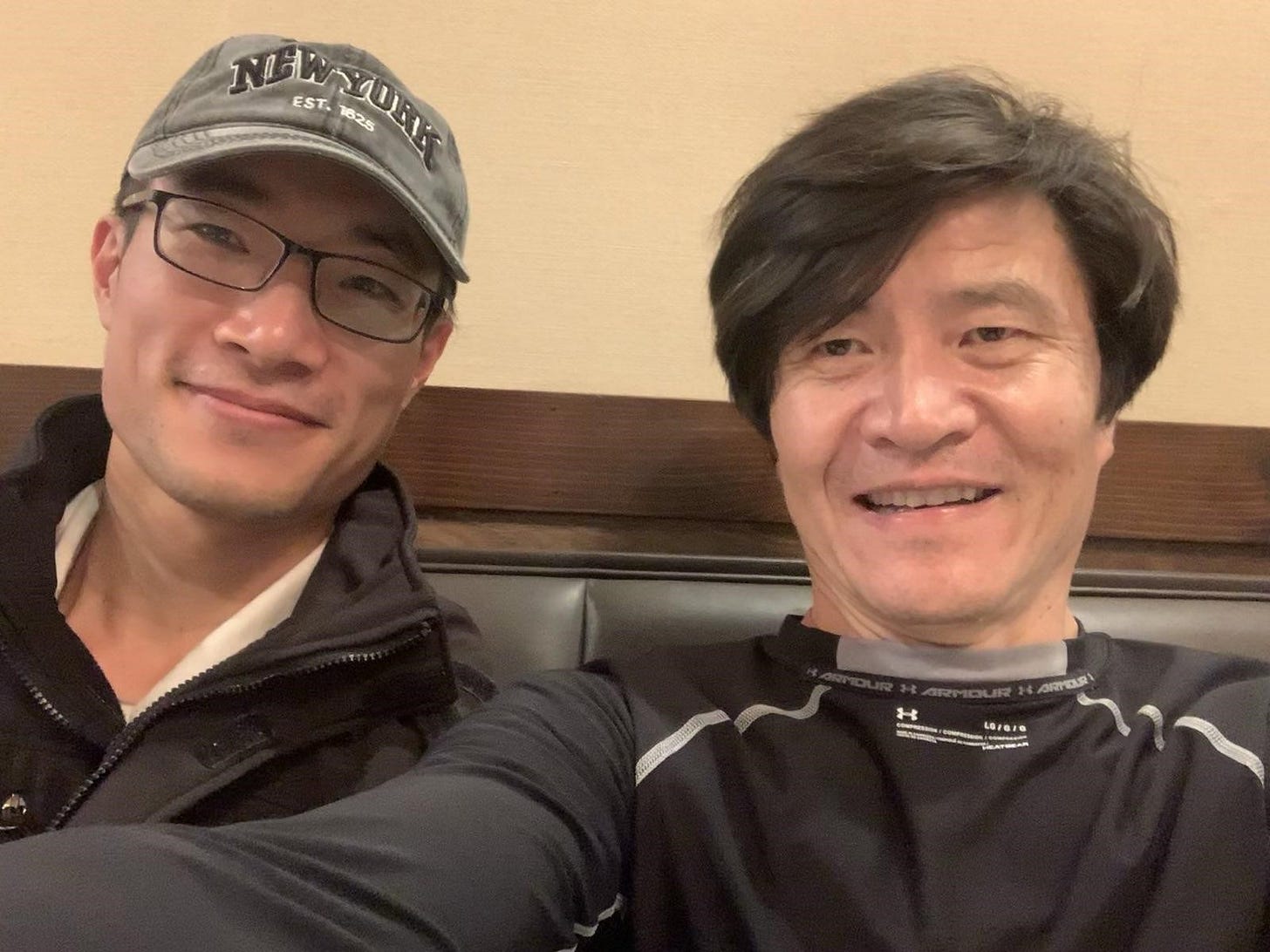
A photo of Fengsuo Zhou, Executive Director of Human Rights in China, with Guan Heng in November 2021.
“If he gets deported, he’s really dead,” Guan Heng’s mother, Ms. Luo, said shakily in an interview on November 10, 2025. Ms. Luo, currently in Taiwan, is deeply worried about her son’s situation. Her greatest wish is for a fair ruling from the U.S. court to stop ICE’s deportation proceedings and allow her son to remain in the United States. That way, at least he will be safe.
Ms. Luo’s fears are not unfounded; similar tragedies have already occurred. Feng Siyu, a young scholar who graduated from Amherst College in the United States, is one cautionary example. She visited the Center for Folklore Studies at Xinjiang University in 2017, and collaborated with the center’s director, the renowned anthropologist Rahile Dawut, on research into Uyghur folk culture. However, Rahile Dawut was arrested in December 2017 and sentenced to life imprisonment the following year. Feng Siyu was also suddenly arrested in 2018 and ultimately sentenced to 15 years in prison.
Now, efforts from Pulitzer Prize winners, filmmakers, Uyghur leaders, and human rights activists are attempting to build a “protective wall” to block ICE’s deportation process, in order to protect Guan Heng and secure his freedom.
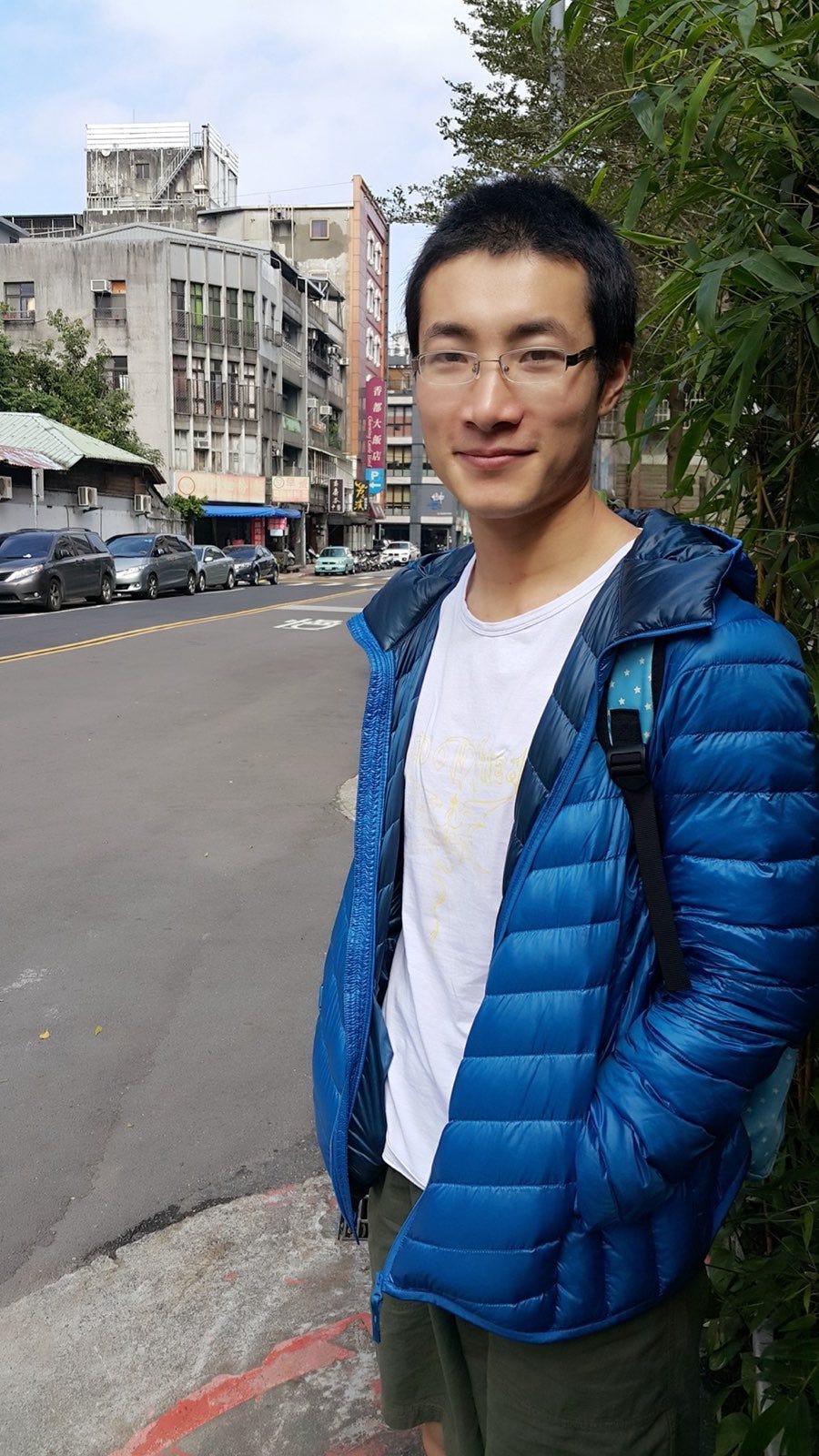
Guan Heng in Taiwan in 2019
On October 20, 2025, in a New York State prison, Guan Heng, dressed in prison garb, awaited his December immigration hearing. When the author of this article connected with him on the phone and told him that the video he risked his life to film was key evidence supporting Pulitzer Prize-winning reporting, he sounded quite surprised.
He said he didn’t regret what he had done. Having gone through all of this, he was even more convinced that what he did was “right.”
“Because I am now personally experiencing the taste of losing my freedom, I can better understand the feelings of those in concentration camps,” he said in a phone call from prison. “I need help from the outside world now, and so do they. So, I still believe I did the right thing back then.”
“I think this is a huge, unchecked, and uncontrolled crime being committed by the Chinese government,” he added. “It has caused countless families the pain of separation and loss of freedom. So, even now, I remain firmly opposed to everything the Chinese government is doing in Xinjiang.”
But as an “illegal immigrant” who has already lost his freedom, his only hope now lies in emergency assistance from lawyers, journalists, and human rights organizations in the outside world.
On December 15th, Guan Heng’s asylum hearing will be held in New York. His fate hangs in the balance, depending on one question: will the free world he ran towards no matter the cost ultimately choose to protect him, or will it send him back to the homeland where he risked his life to expose its dark secrets, and ultimately fled for the sake of freedom and justice?