(bbc.co.uk)
Look, a new (shorter) day has begunpublished at 10:51 GMT 21 December
 Tinshui Yeung
Live reporter
I was a bit worried about what might happen today, especially since just a few days ago the weather forecast said there could be rain at Stonehenge.
But as it turns out, there is no rain - unless you count the downpour of drumsticks and the pitter-patter of dancing feet as people sing and sway near the stones.
Humans have been at this for centuries. We did it again this year, and you can bet we will be back next year, and the year after, and the year after that...
This brings our live coverage to an end, we hope you enjoyed watching the sunrise with us. Have a happy weekend.
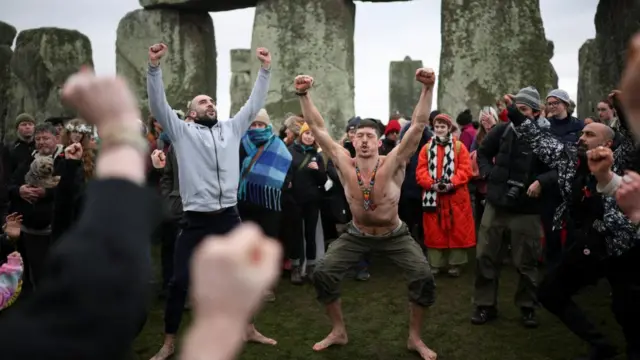 Image source, Reuters
This is my picture of the day, by the way
A lot of joy and emotion at start of winter solsticepublished at 10:47 GMT 21 December
 Sophie Parker
Reporting from Stonehenge
BBC's Sophie Parker has been reporting from Stonehenge this morning, on the day of the winter solstice. Here are her reflections.
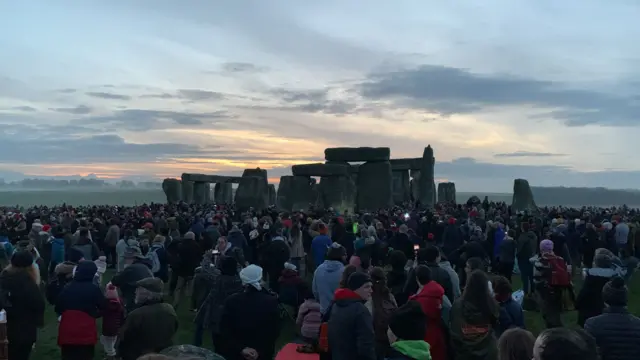
With 8,500 people at Stonehenge, the stone circle was busy, with this being one of the rare opportunities for people to get up close to them.
It can be difficult to get the middle, you have to be there early.
There was drumming for hours, plenty of cheering and even people being taught to Morris dance.
Many come for the spiritual experience, who are part of the pagan communities or who have always dreamed of seeing it, which means a lot of emotion there too.
My hands were slowly getting colder throughout the morning but the weather was quite mild for December.
While there was lot of joy, there wasn't a unified moment of cheering for the sunrise - likely because of the cloud.
'We beat the crowds to watch sunrise a day early, and ran home from Stonehenge'published at 10:34 GMT 21 December
Alex Akhurst
BBC Your Voice
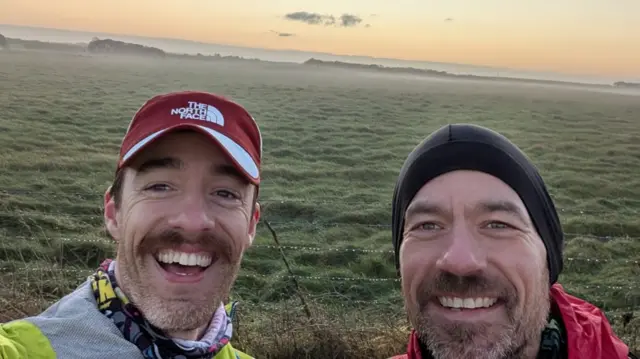
Rob, 38, and Adam, 43, walked to Stonehenge from their homes in Somerset to watch the sunrise together yesterday. They then embarked on a 61km run home, which took 6 hours and 40 minutes.
“We had originally planned today but decided to beat the crowds and do it one day early. It was so peaceful to experience it by ourselves almost on solstice,” says Rob.
"It was a special - if extremely challenging - way to celebrate the solstice. Hoping to do it again for summer solstice.
"I've done marathons before, but Adam hasn't. For both of us it was by far the furthest we've ever run."

The winter solstice - how the morning unfoldedpublished at 10:22 GMT 21 December
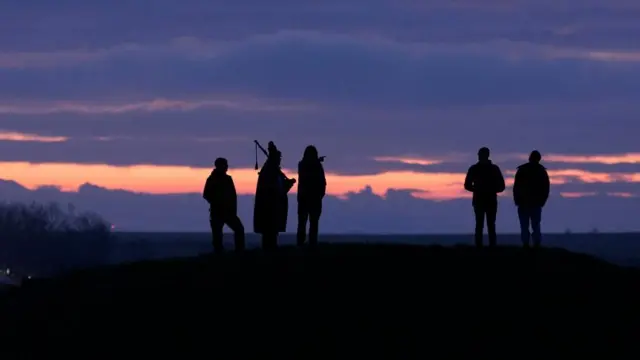 Image source, PA Media
In case you missed this morning's sunrise (it is a Sunday after all), we've taken a look back at why it's been making headlines.
The UK - along with much of the world - is celebrating the winter solstice, the shortest day of the year in the northern hemisphere.
About 8,500 people descended on Stonehenge this morning as the gates swung open at 05:15. (And if you’re asking "why Stonehenge?", we’ve got that covered)
"We're coming out of the darkness and then into the light again," Kim tells our reporter Sophie Parker, who’s been braving the cold at the stone circle. We'll have more from Sophie shortly.
Before 08:00, the sky was already brightening. The Sun finally made its entrance at 08:09 – cue cheering crowds and dancers doing what they do best, as they have for years and years.
"This is the time of the year that people in prehistory really revered and it was really important to them," says Win Scutt from English Heritage, which manages Stonehenge.
The Sun is well and truly up, so stay with us.
Big crowds at Stonehenge - how many people attended?published at 10:03 GMT 21 December
As we've been reporting, thousands of people watched the Sun rise over Stonehenge.
We've just heard that the crowd peaked at 8,500, despite the cold weather.
Back in June, around 25,000 people attended the summer solstice.
Drums, dancing and big smiles: Crowd welcomes shortest daypublished at 09:56 GMT 21 December
We can bring you some more pictures from Stonehenge.
A little earlier, as the sun rose, people sang, danced and played music while others took a quiet moment with the ancient stones.
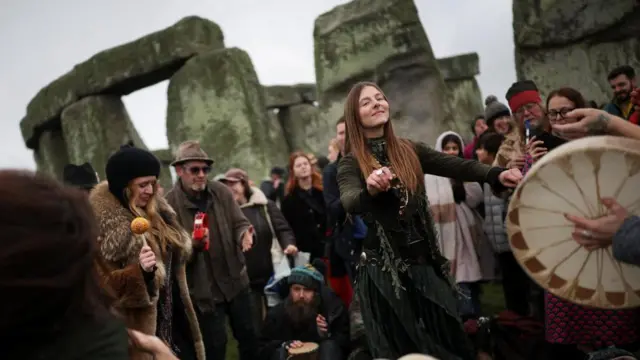 Image source, Reuters
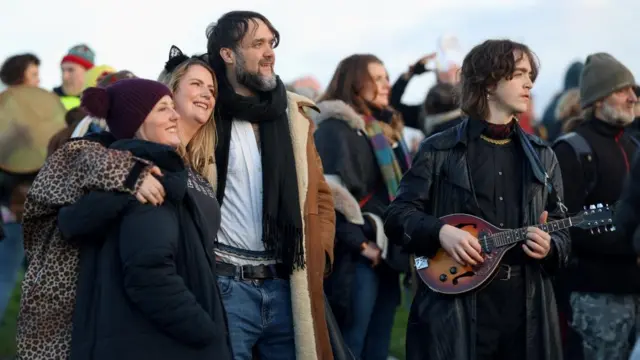 Image source, Reuters
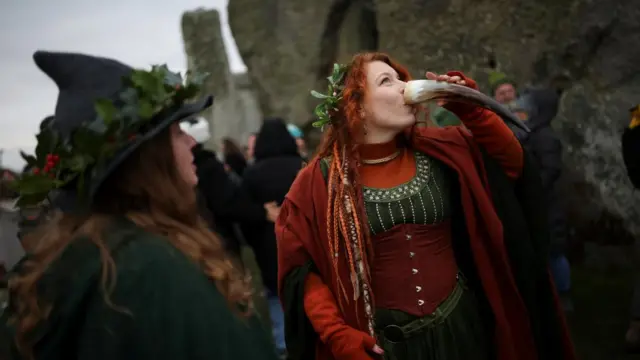 Image source, Reuters
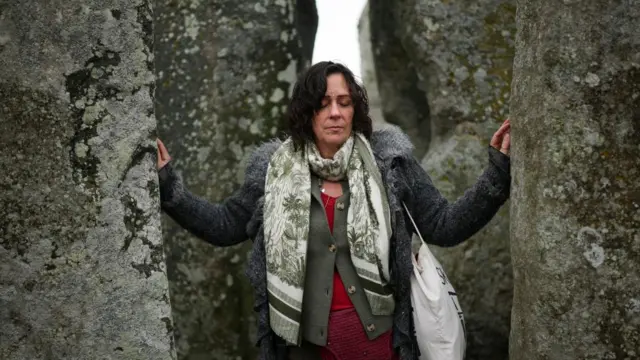 Image source, Reuters
'New life and hope in the air, the perfect way to celebrate'published at 09:39 GMT 21 December
Sophie Parker
Reporting from Stonehenge
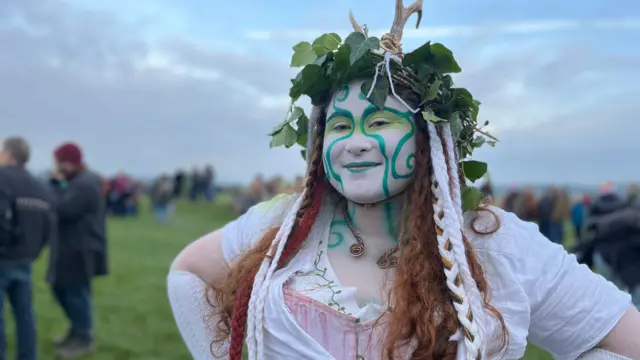
Sophie McCarthy has travelled down from Edinburgh, equipped with a costume and a set of drums, specifically to join the pagan celebration.
"The winter solstice is all about life returning, the sun has been born anew," she said. "There's lots of intention, new life and hope in the air. It's been beautiful.
"I was in the very middle of the stones, surrounded by lots of new friends who were all drumming and creating really magical noise together, spontaneously in the moment.
"Which for me, was the perfect way to celebrate the sun rising."
Watch: Timelapse of sunrise over Stonehenge on winter solsticepublished at 09:26 GMT 21 December
'Stonehenge ticked off my bucket list,' says Australian man on European tourpublished at 09:13 GMT 21 December
Sophie Parker
Reporting from Stonehenge
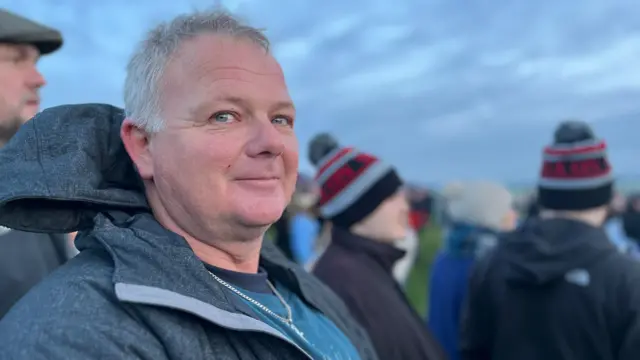
Bradley O'Neill, who travelled from Australia, is on the first stop of his bucket list tour around Europe.
"This was one of my long time wishes, to see Stonehenge" he said.
"I just like old mysteries. The world is full of questions and I'm not going to get many answers either, but I'm sure going to see something special.
"Today we get to touch the stones and feel the energy. The presence they have, it's actually fantastic. I feel special, in my heart" he added, his eyes welling with tears.
Want to share your stunning pictures of the sunrise? Get in touchpublished at 09:00 GMT 21 December

Are you observing the winter solstice?
You can share comments, pictures and videos with us in the following ways:
- Email: yourvoice@bbc.co.uk
- WhatsApp: +44 7756 165803
- Upload pictures or video, external
- Tag us on X: @BBC_HaveYourSay, external
- Please read our terms & conditions and privacy policy
'It's spectacular to see so many people from different cultures'published at 08:54 GMT 21 December
Sophie Parker
Reporting from Stonehenge
 Image source, BBC / Sophie Parker
Golnar Pooya is a Persian Zoroastrian – one of the world’s oldest monotheistic religions – and she tells me celebrating the winter solstice is a major part of that tradition.
"We stay up all night, we have a lot of pomegranate – which symbolises birth, rebirth and life," she says. "And we gather with family, we read poetry until the Sun rises, and the celebration is that the darkness is now over."
The same night has been celebrated by Persians across the world for more than 2,500 years, she says. "For us it’s not a religious event, it’s more a tradition."
This is Golnar’s first time celebrating the winter solstice at Stonehenge. She's visiting the UK from the US.
"It’s spectacular to see so many people from so many different cultures coming together, from so many different regions, just to see the Sun rise and light come back to Earth."
Dance, music and festivities at Stonehengepublished at 08:48 GMT 21 December
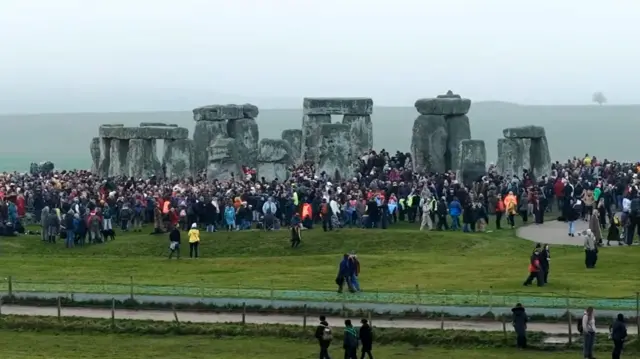 Image source, English Heritage
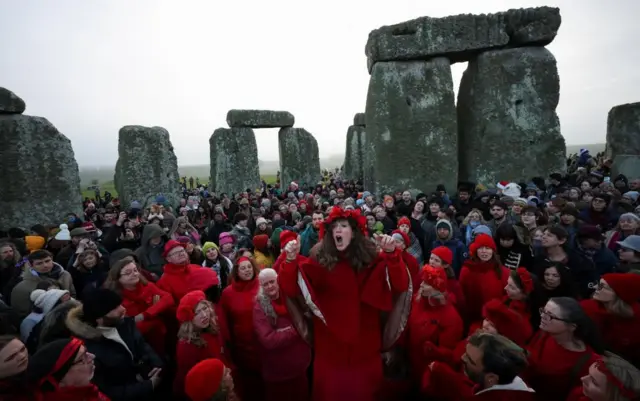 Image source, Reuters
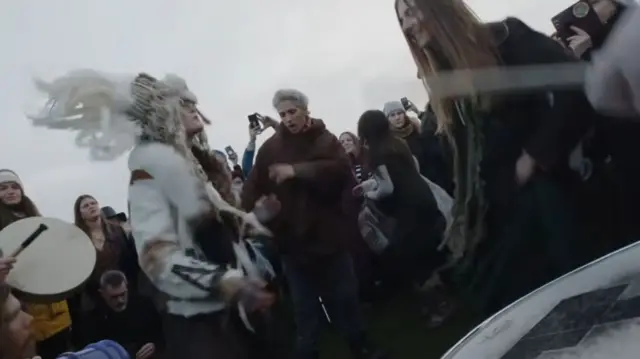 Image source, English Heritage
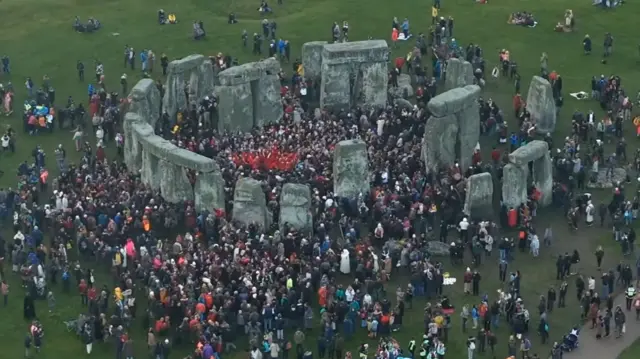 Image source, English Heritage
A quick look at winter solstice celebrations around the worldpublished at 08:45 GMT 21 December
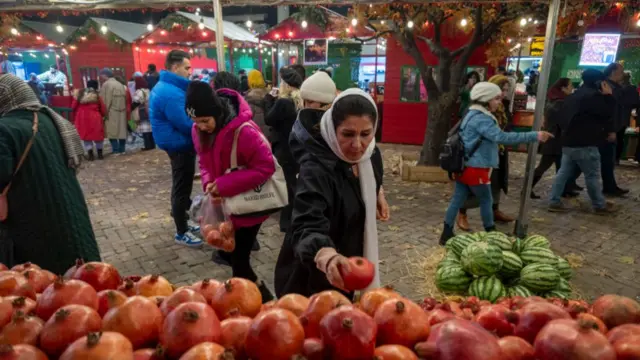 Image source, NurPhoto/Getty Images
In Iran, pomegranates are a big part of the celebrations
The longest night of the year in the northern hemisphere is marked by different events and traditions around the world.
In Iran and Central Asia, many celebrate the Persian festival of Yalda, with families and friends gathering - often staying awake all night to eat, drink and read poetry. Nuts and fruits, especially red fruits like watermelon and pomegranate, are traditionally eaten. The occasion celebrates the triumph of light over darkness.
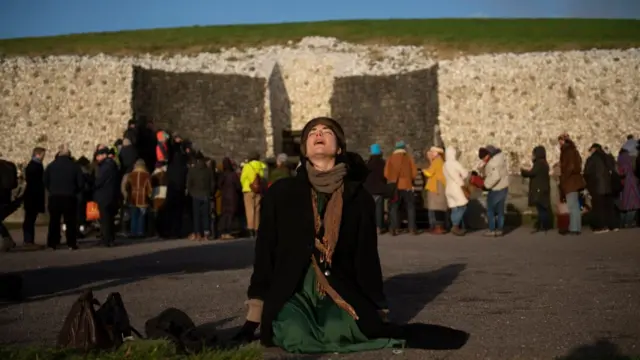 Image source, Getty Images
Crowds gather at Newgrange in Ireland to watch the sun
In Ireland, people gather at Newgrange in County Meath. The mound is thought to be older than Stonehenge, dating from 3200 BC. A gap in the structure is positioned so that during the shortest days of the year, the dawn sunlight illuminates an inner chamber.
In China, today is the Dongzhi festival, which roughly translates as "winter’s arrival". Families get together to share a meal with traditional foods, such as rice balls called Tang yuan.
And for perhaps the coldest winter solstice celebration - in Antarctica - some scientists at research stations mark the slow return of the sun by cutting a hole in the ice and taking a freezing cold dip.
 Image source, VCG/Getty Images
Some parts of China also make and eat dumplings during the festivities
How old is Stonehenge?published at 08:25 GMT 21 December
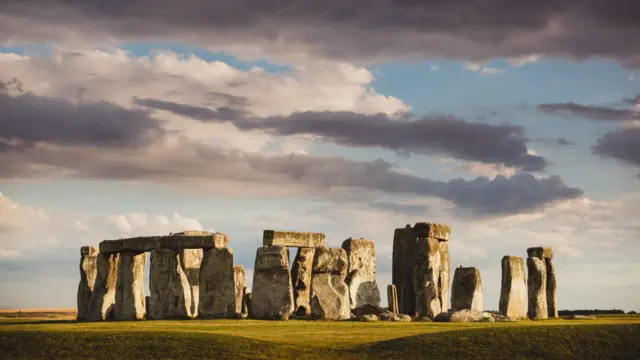 Image source, Getty Images
As we've just reported, Win Scott of English Heritage says the winter solstice is a revered cultural moment in ancient history.
Thousands gathered today at the prehistoric monument Stonehenge to watch the Sun rise - but how old is it?
Stonehenge was built in several stages, according to English Heritage. The oldest part dates back to around 5,000 years ago.
The charity that manages Stonehenge says the earliest known significant monument at the site was a circular ditch built in around 3,000 BC. The ditch created an area about 100m (328ft) in diameter with two entrances, and is considered an early form of henge - a prehistoric circular enclosure.
The stones associated with the site are thought to have been placed there in around 2,500 BC.
But Stonehenge’s immediate surrounding area may have an even older history.
It includes several pits, three of which may have held large "totem-poles" between 8,500 and 7,000 BC.
It’s not known how these posts relate to the later monument of Stonehenge.
'A significant cultural event in ancient history'published at 08:22 GMT 21 December
Sophie Parker
Reporting from Stonehenge
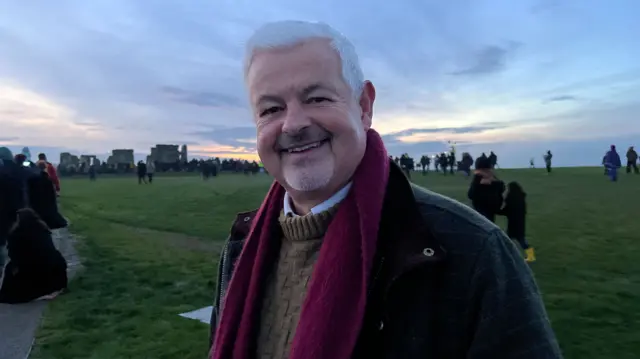
Win Scutt from English Heritage says although the stones align with both the midwinter and midsummer sunrise, the winter solstice has always been more significant in the cultural calendar.
"This is the time of the year that people in prehistory really revered and it was really important to them," he told the BBC.
"We've done excavations near here that show they were killing pigs to feast on in the midwinter celebration. We know that it's in midwinter because the pigs are eight months old, and the sow's farrow in the spring."
Mr Scutt confirmed visitors are allowed to gather closer to the stones than ever before, but urged people to treat them delicately.
"We've got really rare lichens on them and incredible carvings on them, so I'm hoping that people will respect the stones," he added.
Revellers celebrate winter solstice - in picturespublished at 08:20 GMT 21 December
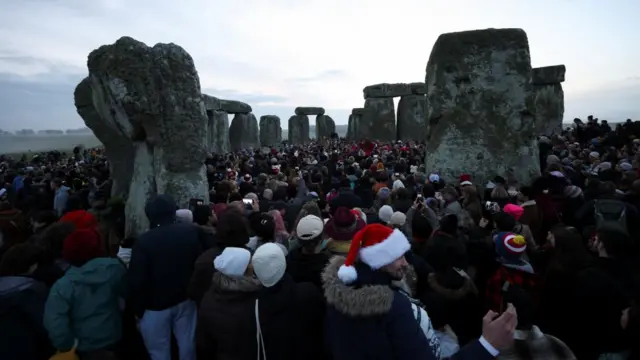 Image source, Reuters
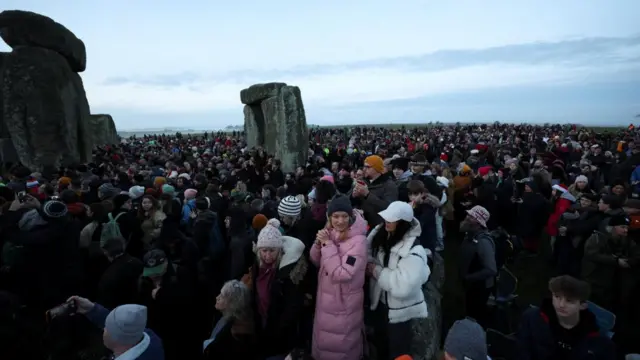 Image source, Reuters
Cheers from crowds as Sun rises - watch livepublished at 08:12 GMT 21 DecemberBreaking
It's now 08:12 GMT and the Sun is rising at Stonehenge.
Thousands of people are at the monument to celebrate the winter solstice - we'll bring you more shortly.
Morris dancers celebrate promise of longer days to comepublished at 08:04 GMT 21 December
Sophie Parker
Reporting from Stonehenge
The winter solstice is the darkest, shortest day, and many perform Morris dances to celebrate the Earth being "reborn" and the promise of longer days to come.
The folk dance is a symbolic ritual to mark the turning of the year and connect with ancient traditions of fertility and nature.
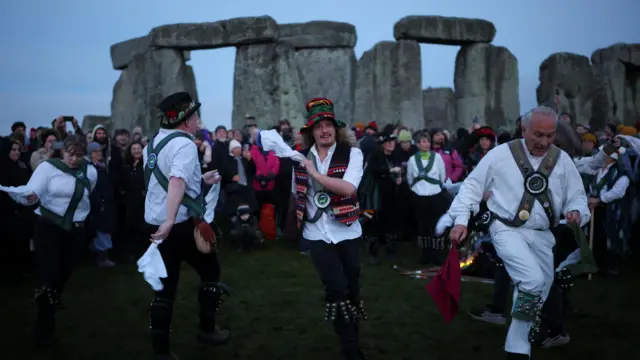 Image source, Reuters
'We woke up at 2am and drove three hours to watch sunrise'published at 07:55 GMT 21 December
Sophie Parker
Reporting from Stonehenge
Emma, Tom, and Bella Ridley-Thompson woke up at 02:00 GMT this morning for the "ancient and spiritual" event.
The family packed their car and began the long journey down from Nottingham to catch the first rays of Sun as they burst through the stone arches.
They have done so for each winter solstice over the past three years.
"It's just nice to get involved," said daughter Bella. "This is a ceremony after all, so it's nice to dress up and have a bit of respect.
"I'm very excited to be here, see the Sun and take some pictures."
Watch live as Sun rises at Stonehenge on winter solsticepublished at 07:50 GMT 21 DecemberBreaking
Sunrise is almost here, and thousands have gathered at Stonehenge this morning to celebrate the winter solstice.
You can watch the sunrise, and see the crowds, by clicking Watch live at the top of this page.