Bare-knuckle boxing was a bloody sport, governed loosely first by the Broughton Rules (1743), which allowed everything but hitting a man below the waist or beating on a downed opponent. Later, the London Prize Ring Rules (1838) outlawed kicking, eye gouging, head butts, and biting. Under either set of rules, it was permissible to grab your opponent and throw him to the ground... or hold your opponent by the hair or neck and punch him repeatedly, Nolan Ryan style!
Under either set of rules, the rounds were not timed. Instead, a round ended when a man was knocked down. Under the Broughton Rules, the downed opponent had 30 seconds to stand up and return to the center of the ring, or he was determined knocked out. The London Prize Ring Rules introduced the idea of breaks between rounds: after a knock-down, each man went to his corner. (The downed man could be carried, if necessary!) Then, after 30 seconds, each man had eight seconds to return to the center of the ring, or be called knocked out.
There was no penalty for being knocked down, and often a tiring boxer would simply "take a knee" to end a round and get his 30 seconds to recover. Some fights went for dozens of rounds -- including the 276-round contest between Jack Jones and Patsy Tunney in 1825.
But because the rounds were untimed, the number of rounds didn't determine how long the match was. And in 1855, two men squared off in what is now remembered as the longest -- and maybe most boring -- bare-knuckle boxing match in history. It was just 17 rounds, meaning there were "only" 17 knockdowns. Near the end of the fight, the two exhausted men simply stood, arms crossed, and stared at each other. Many bored spectators left long before the fight was over.
James Kelly -- sometimes known as "Australian Jim," though he was born in Ireland in 1831 -- had fought in Britain and the U.S. before traveling to Australia to find new foes there. He gained attention by defeating a local fighter named "Hammy." Jonathan Smith, who had been a professional fighter in Britain before enlisting in the British Army, then sought his fortune in Australia as a gold prospector, challenged Kelly to a fight with a £300 purse. Smith was taller and heavier, but also 11 years older.
The bout was to be fought on Smith's "home turf," a flat area near gold mines near Fiery Creek west of the city of Ballarat in the Central Highlands of Victoria, Australia.
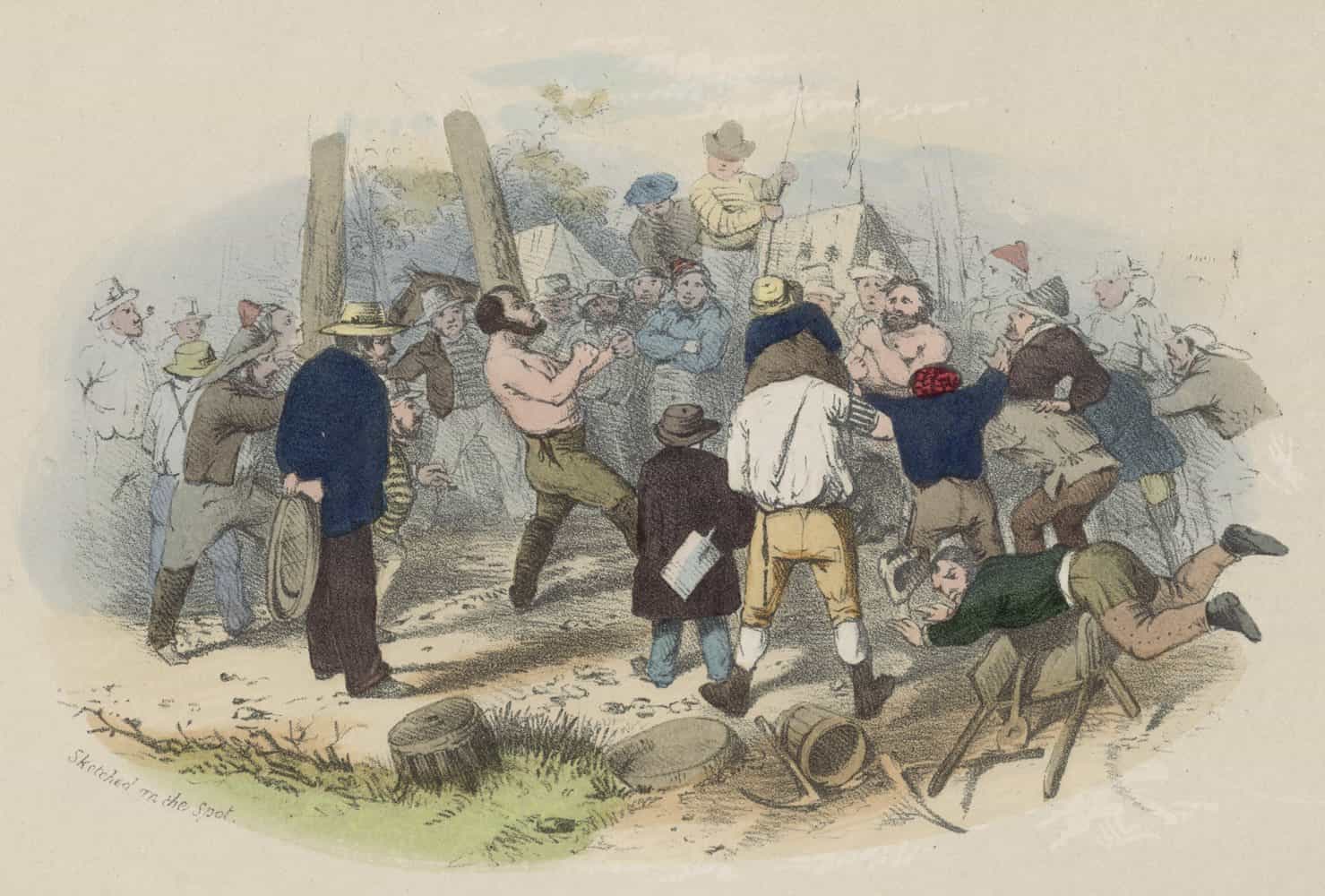
Prize fighting was illegal, so to keep the police away the fight had to be fought in secret -- or bribes paid out. In any event, no authorities put a stop to the bout when it began at 9 a.m. on the hot, sticky summer morning. Spectators crammed in tight around the roped-off ring where the two bare-chested men stood, with children climbing gum trees for a better view.
At the start of the fight, they flipped a coin to determine which fighter would pick his starting position. The Irishman won, and he stood in a spot where to face him, Smith would be facing east -- an important consideration for outdoor fighting. Smith would be staring into the sun at the start of the fight and after every round... at least until the latter parts of the fight. It went so long that by the end, the afternoon sun was in Kelly's eyes!
Smith landed the first blow, a glancing left to Kelly's neck, and he retorted with a left to Smith's mouth. With no mouthguards or other obstructions, they freely talked trash to each other: "I only want to see your 'claret'," Kelly sneered, "then I’ll make you fight."
Smith may have been outmatched by the younger, faster, more skilled Kelly, but he had a considerable advantage in reach. The two darted around the ring, Kelly trying to get inside, Smith trying to keep his distance. The bored crowd grew listless, many jeering the lack of action.
Finally, after more than two hours of dancing around the ring with little action, they exchanged a flurry of blows that sent both men to the ground. The crowd roared its approval at this action, though their cheers did little to change either man's strategy, and when the fight resumed, so did the dancing.
The fight continued into a third hour, then a fourth and a fifth. Kelly was bleeding freely from his nose, getting blood all over himself and his opponent. At one point, there was nearly an hour of "sparring, feinting, stepping back, etc.," without a round ending because neither man went down.
Finally, after about six hours, the two exhausted men could no longer chase each other. Smith, still using his reach advantage, didn't want to attack Kelly, while Kelly, the more skilled boxer, wanted to counterpunch rather than initiate.
So the two exhausted men just stood there, arms crossed, staring at each other from a few feet away -- each daring the other to attack first.
The crowd, well lubricated on beers sold by enterprising vendors at the site, began hissing and booing at the two stationary fighters.
Finally, Kelly had enough. "Are you going to fight?" he snarled. "It will never come off if you don't."
Smith then threw a left, which the skilled Kelly dodged and countered with a sharp blow to Smith's neck.
At this Smith simply gave up.
The two men shook hands in front of what was left of the crowd -- many of whom were unsure that the fight, after more than six hours, had ended so abruptly and anti-climactically.
Philo Beddoe