(theguardian.com)
Putin calls European leaders 'little pigs' as he insists Russia will achieve its goals in Ukraine by diplomacy or force

Pjotr Sauer
Russian affairs reporter
Meanwhile, Russia’s Vladimir Putin on Wednesday lashed out at European leaders, deriding them as “little pigs”, and said Russia would achieve its territorial goals in Ukraine either through diplomacy or by military force.

Speaking at an annual meeting with the defence ministry, Putin said the aims of what Moscow calls its “special military operation” would be met “unconditionally”.
“If they do not want a substantive discussion,” he said, “then Russia will liberate its historical lands on the battlefield.”
Putin claimed that the previous US administration had “deliberately steered the situation towards an armed conflict”, adding that Washington believed Russia could be weakened or even destroyed in a short period of time.
He then lashed out at European leaders, accusing them of joining in with Joe Biden’s administration. “Europe’s little pigs immediately joined in the work of the previous American administration, hoping to profit from the collapse of our country,” Putin said.
Putin’s hardline comments came as US officials claimed that earlier talks with Ukraine in Berlin had resolved about 90% of the most difficult issues. But major doubts remain over whether the Russian leader is prepared to compromise on his sweeping demands.
Putin has repeatedly insisted that Kyiv cede the remaining parts of the eastern Donbas region still under Ukrainian control – a demand that the White House has at times appeared to endorse, but which Ukraine has flatly rejected. Moscow has also pushed for strict limits on Ukraine’s military, a ban on western troops on Ukrainian territory, and an end to western military support.
The Russian leader on Wednesday also denied that Moscow was planning to invade Nato territory, claiming instead that the alliance had begun preparing for a possible military confrontation with Russia, with a view to 2030.
Key events Spain's Sánchez criticises plans to water down ban on new petrol, diesel cars as 'historic mistake' Closing summary Belgian politicians and finance bosses targeted by Russian intelligence over seized assets All you need to know about EU's proposals to use frozen Russian assets to fund Ukraine Zelenskyy urges EU to send message to Moscow that continuing war is 'pointless' Britain's return to Erasmus 40 years on from scheme's creation gets more enthusiastic comments than in 1987 UK's move to rejoin Erasmus+ 'significant step' for EU, UK universities, groups say Germany's Merz says will work with EU partners to alleviate concerns on use of frozen Russian assets Merz calls for EU move on frozen assets to put pressure on Russia as he warns against Moscow's ambitions EU's use of Russian frozen funds needs 'solid legal basis' or we risk handing Putin 'victory', Meloni warns Confiscating Russian assets to fund Ukraine would be 'declaration of war,' Hungary's Orbán warns Putin calls European leaders 'little pigs' as he insists Russia will achieve its goals in Ukraine by diplomacy or force UK will demand £2.5bn of Abramovich cash to be transferred to Ukraine fund, Starmer says, telling oligarch 'pay up now' or face court France will 'firmly oppose' EU-Mercosur deal, government spokesperson says UK rejoining Erasmus+ 'strong signal in favour of closer cooperation' in higher education, German universities chief says 'Far from easy' to get EU agreement on frozen Russian assets, Meloni says, as she hints at Mercosur deal delay No deal yet on exempting UK from new import taxes on carbon emissions of goods manufacturers outside EU Erasmus move 'symbolic milestone in reset' between EU, UK, German lawmaker says Share your views on the UK rejoining the EU Erasmus student exchange programe UK to rejoin EU’s Erasmus student exchange programme 'Big step forward,' EU chiefs say as they welcome UK's decision to rejoin Erasmus UK set to rejoin EU's Erasmus scheme in 2027 US looking at fresh sanctions on Russia's energy sector to push it to negotiate with Ukraine - reports Who stands where on EU reparations loan for Ukraine? Morning opening:
Spain's Sánchez criticises plans to water down ban on new petrol, diesel cars as 'historic mistake'

Sam Jones
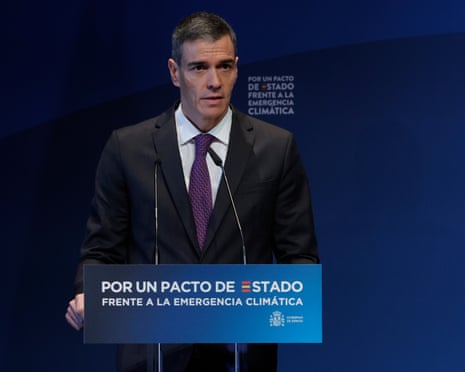
Under current legislation, manufacturers were obliged to ensure that 100% of production of cars and vans had zero emissions from 2035.
The European Commission has now proposed reducing this to 90%, enabling the continued manufacture of a portion of plug-in hybrid electric cars, or even combustion engines beyond 2035.
Speaking in Madrid on Wednesday to promote his proposed state pact to address the climate emergency, Sánchez hit out at the plans, saying:
“What was approved in the European parliament yesterday was a historic error for Europe because competitiveness … is guaranteed by sustainability and not by weakening our climate commitments and our support for sustainability.”
He added: “Climate is the board on which all the other games are played. There’s no progress, no growth and no health of the climate becomes a risk factor.”
Spain is one of the European countries on the frontline of the climate emergency, having suffered deadly floods last year as well as summer after summer of wildfires.
Measures in the pact include funds to prepare for, and rebuild after, climate-related disasters, improvements to firefighting capacity, a plan to increase water resilience in the face of floods and droughts, and initiatives to fight rural depopulation and thus help keep the land clear of combustible material.
Sánchez said the raft of initiatives – which will be put before parliament – was designed to act as “a shield for Spain” and to protect its people and its economy.
“The climate emergency won’t wait,” he said. “[And] history will not forgive a lack of action. What’s in play here is the future of this who will come next. Let’s do it together before it’s too late.”
Closing summary

Jakub Krupa
… and on that note, it’s a wrap for today!
-
Russia’s Vladimir Putin on Wednesday lashed out at European leaders, deriding them as “little pigs”, and said Russia would achieve its territorial goals in Ukraine either through diplomacy or by military force (14:10) in highly contentious comments a day before the European leaders meet in Brussels to decide on the use of frozen Russian assets to fund Ukraine (18:39).
-
Ukrainian president Volodymyr Zelenskyy has urged European allies to show their support to Kyiv and send a clear signal to Moscow that continuing its war is “pointless,” telling them “it is for Europe to make this choice” (18:06). He will attend the Brussels summit in person (18:55).
-
Germany’s Friedrich Merz said he would continue to push for a decision to be made on the frozen assets saying the pressure on Putin must be increased even further in order to persuade him to engage in serious negotiations (16:11, 16:16).
-
But Belgium, Italy, Hungary and the Czech Republic are in a group of countries that remain unconvinced about the idea, fearing backlash from Russia (10:00, 12:37, 14:52, 15:07).
-
Belgian politicians and senior finance executives have been subject to a campaign of intimidation orchestrated by Russian intelligence aimed at persuading the country to block the use of €185bn assets for Ukraine, according to European intelligence agencies (18:47).
-
The UK has told Russian oligarch Roman Abramovich to hand over £2.5bn from his sale of Chelsea FC to humanitarian causes in Ukraine, telling the billionaire to commit the funds or face court action (13:25).
-
Meanwhile, the UK has struck a deal with the EU to rejoin Erasmus+ from 2027, a move hailed by EU and UK universities as a “significant step” in post-Brexit reset of relations (10:39, 10:44, 11:02, 11:09, 11:22, 12:14, 16:42).
And that’s all from me, Jakub Krupa, for today.
If you have any tips, comments or suggestions, email me at jakub.krupa@theguardian.com.
I am also on Bluesky at @jakubkrupa.bsky.social and on X at @jakubkrupa.
Back tomorrow for the European Council action!
But before we get to tomorrow’s European Council meeting on Ukraine, there is a separate EU-western Balkans summit tonight, with representatives of five Balkan countries hoping to join the European Union attending the talks.
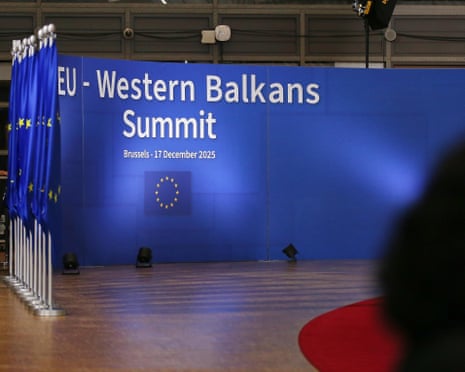
Albania’s Edi Rama is there – you can’t miss him, can you – as well as Kosovo president Vjosa Osmani, Montenegrin president Jakov Milatović, North Macedonia’s prime minister Hristijan Mickoski, and Bosnia and Herzegovina’s Željko Komšić.

Curiously, Serbia’s Aleksandar Vučić chose to skip the meeting, in what felt like a jibe on the EU’s negative assessment of Serbia’s progress on its road to accession.
“By doing this, I believe I am protecting the Republic of Serbia and its interests, because we need to show what we have achieved,” he said.
The EU said it took note of Vučić’s decision and regretted it.
Jakub Krupa
Oh, and Ukraine’s Zelenskyy is expected to join the EU leaders in Brussels tomorrow to make his case in person, too.
Belgian politicians and finance bosses targeted by Russian intelligence over seized assets
Dan Sabbagh in London and Jennifer Rankin in Brussels
Belgian politicians and senior finance executives have been subject to a campaign of intimidation orchestrated by Russian intelligence aimed at persuading the country to block the use of €185bn assets for Ukraine, according to European intelligence agencies.
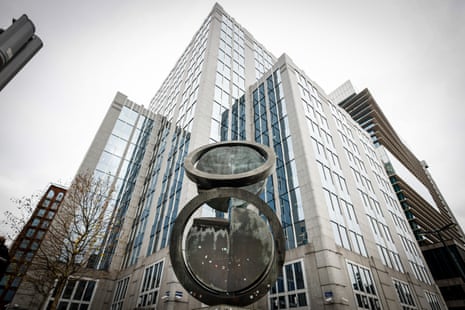
Security officials indicated to the Guardian that there had been deliberate targeting of key figures at Euroclear, the securities depository holding the majority of Russia’s frozen assets, and leaders of the country.
EU leaders meeting in Brussels on Thursday are debating whether to approve the lending of urgently needed funds for Ukraine secured on Russian central bank assets, critical to maintain Kyiv’s war effort through 2026 and 2027.
Officials believe the campaign is the responsibility of Russia’s GRU military intelligence, though there is a debate about the degree of threat. “They have been engaged in the tactics of intimidation for sure,” one European official said.
Belgium is in focus because €185bn (£162bn) of the €210bn of Russia central bank assets frozen by the EU since the start of Moscow’s full-scale invasion of Ukraine is held at the Brussels-based Euroclear.
Russia has publicly warned that utilising the assets would amount to theft and its central bank said it is seeking $230bn in damages from Euroclear in a case brought in the country’s courts. But it is understood the intimidation campaign has been focused on key individuals.
Threats have been directed at Valérie Urbain, the chief executive of Euroclear, and other senior executives at the financial services group.
Euroclear declined to comment: “Any potential threats are treated with the utmost priority and investigated deeply, often with the support of authorities as appropriate.”
All you need to know about EU's proposals to use frozen Russian assets to fund Ukraine

Jennifer Rankin
in Brussels
After months of debate, EU leaders will decide on Thursday whether or not to use Russia’s immobilised assets to fund Ukraine in what could be a make-or-break moment for Europe.
So, what is the plan (it’s complicated), why now, what Russia does say (you can guess), why does Belgium oppose the idea (in one word: Euroclear), what’s the alternative (no easy way out), and what if it doesn’t get adopted?
Here is “everything you ever wanted to know about the EU’s plan to use frozen Russian assets, but were too afraid to ask.”
Zelenskyy urges EU to send message to Moscow that continuing war is 'pointless'
Meanwhile, Ukrainian president Volodymyr Zelenskyy has urged European allies to show their support to Kyiv and send a clear signal to Moscow that continuing its war is “pointless.”
In his evening address, published on Telegram and his website, Zelenskyy said that Moscow keeps sending signals it’s preparing for further confrontation, and “it is important that partners see this, … in particular partners in the US, who often say that Russia supposedly wants to end the war.”
(He means US president Donald Trump.)
“We need real protection from this Russian history of madness, and now we will continue to work with all partners to ensure that such protection is truly there,” he said.
“The outcome of these meetings – the outcome for Europe – must be such that Russia feels that its desire to continue fighting next year will be pointless, because Ukraine will [continue to] have support,” Zelenskyy said.
He said this outcome depended in “100%” on Europe’s decision and “it is for Europe to make this choice.”
“We also expect that our representatives this week will continue the conversation and meetings with the American team about steps that can work for peace and guaranteed security,” he added.

Lisa O’Carroll
We have seen some rumours online suggesting that Keir Starmer could attend European Council tomorrow, but they have been dismissed as untrue by senior sources in Brussels.
“It has never been on the cards,” we were told.
Britain's return to Erasmus 40 years on from scheme's creation gets more enthusiastic comments than in 1987

Jason Rodrigues
The UK government’s announcement that the EU’s Erasmus scheme will reopen to UK students for the first time since Brexit marks a far more enthusiastic drive towards closer relations with Brussels than was evident when the scheme was devised in 1987.
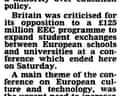
At the time, the Conservative government was accused by the European Economic Community of taking a very “narrow view” and of being unwilling to “take its share of the cost” of the proposed Erasmus programme, as reported by the Guardian.
Although the UK signed up to the Erasmus scheme when it began in 1987, it withdrew after Brexit, with Boris Johnson claiming that the programme did not offer value for money.
Here’s more on today’s return:
UK's move to rejoin Erasmus+ 'significant step' for EU, UK universities, groups say
Jakub Krupa
Meanwhile, EU and UK university umbrella groups have joined a number of voices (11:22, 12:14, 12:44) welcoming the UK’s decision to rejoin the Erasmus+ programme from 2027, saying it was “a significant step” in strenghtening their post-Brexit cooperation.
In a joint statement, Universities UK and European University Association said the move would “open transformative opportunities for thousands of students and staff.”
Vivienne Stern, chief executive of Universities UK, said the industry looked forward to working with partners “to ensure that the programme plays a pivotal role in rebuilding our international partnerships and delivers the best possible outcomes for the UK.”
EUA’s president Josep M. Garrell said the news was “an excellent early Christmas gift,” welcoming “restoring bridges between our universities.”
He said:
“The benefits of Erasmus+ go far beyond financial support, promoting mutual understanding, respect and freedom – shared values that are more vital than ever in today’s world.”
The French umbrella group, France Universités, also said it was a welcome news, noting that “the UK became an active participant in the Erasmus programme soon after its launch in 1987, so the decision to associate again in 2027 will be a kind of 40th anniversary.”
They said they hoped the UK’s return would give French students a chance to restart their “lifelong love affair” with Britain.
“Compared with the Erasmus+ programme the UK withdrew from, however, the current Erasmus+ programme is more skills-oriented, so there is ample room for giving new orientations to our relationship with the UK through the programme.”
Germany's Merz says will work with EU partners to alleviate concerns on use of frozen Russian assets

Deborah Cole
in Berlin
Merz also said he would continue fighting to make up to €90bn in such assets “usable for Ukraine’s defence”, despite continuing misgivings by key member states including Belgium, where most of the funds are parked.
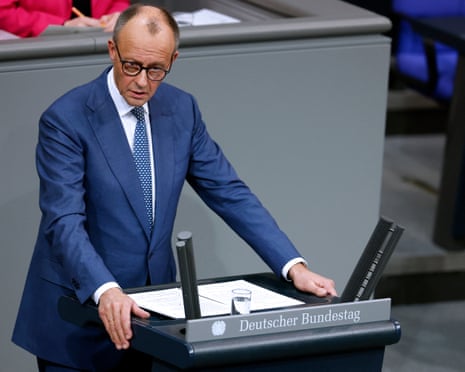
He said he took Belgium’s concerns seriously. “That is why I am trying with our partners to alleviate them,” arguing a plan by the European Commission, the EU’s executive, was “in perfect compliance with international law and international obligations”.
Merz said it was “insufficient” to neutralise “Russia’s war machinery with further sanctions”.
“It is not enough for Europe to keep up our financial support of Ukraine at the current level,” he said. “It is not enough for us to throw all our political weight behind the peace negotiations.”
He put the odds of winning an agreement at “50/50” in an interview with public television late Tuesday.
He also condemned Putin’s rejection of his call on Monday for a Christmas truce in Ukraine “not to be topped in terms of cynicism”.
Merz calls for EU move on frozen assets to put pressure on Russia as he warns against Moscow's ambitions
Jakub Krupa
Speaking in the Bundestag, Germany’s Merz said it was essential for the EU to finalise its reparation loan to use frozen Russian assets to fund Ukraine’s defence to send “a clear signal” for Moscow.
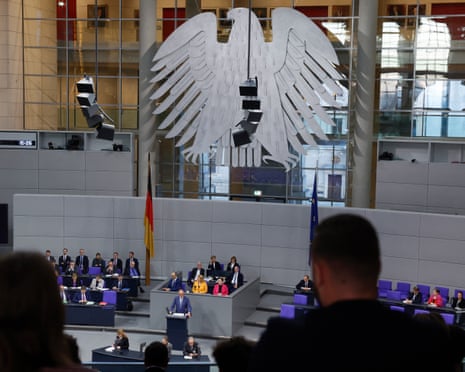
He said that European security “is, and this is becoming particularly clear these days, inextricably linked to the fate and security of Ukraine.” “Inextricably,” he stressed.
Merz welcomed “a great deal of diplomatic momentum” in talks about ending the war, including the Berlin meeting earlier this week, but suggested that Russia’s intentions continued to be confrontational, as it “strives to extend its sphere of influence far beyond its own territory.”
Merz said that as a result, this week’s European Council will have to make decisions “of considerable consequence”
“It is clear that the pressure on Putin must be increased even further in order to persuade him to engage in serious negotiations,” he told lawmakers.
He said the intention was to end the war “as quickly as possible,” and not prolong the war, but the funds would keep Ukraine funded for the next two years if needed.
“That is precisely why we need the decision of the European heads of state and government, and I will personally advocate for such a decision, starting this evening in Brussels,” he said.
Separately, he also said he would “continue to advocate intensively” for the EU leaders to back the Mercosur agreement, allowing the EU representatives to sign it in the coming days – despite opposition from France (13:15) and Italy (12:37).
He argued that if after more than 25 years of negotiations, the EU was to pull its support for the deal, it could question its credibility in trade talks.