(humblymybrain.substack.com)
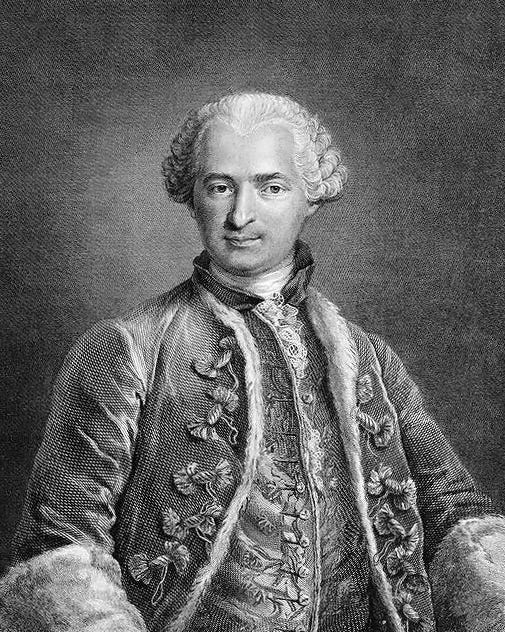
In the early 20th century, as newspapers delved into tales of historical intrigue to captivate readers, the Bismarck Daily Tribune published this fascinating account of the Count of St. Germain—a figure shrouded in myth and deception. Emerging in the opulent court of Louis XV, he captivated Europe’s elite with claims of immortality, alchemical wonders, and timeless wisdom. This 1912 article, blending skepticism with wonder, paints him as one of history’s greatest charlatans, whose origins and fate remain unsolved puzzles. Below is a full transcript of the original piece, preserved with its period-specific language, formatting, and any grammatical quirks.1
He Dazzled the Court of Louis XV, and Said He Had Lived 2,000 Years and Had Concocted an Elixir That Would Keep Him Young and Alive Forever.
One of the greatest impostors in the annals of France and that the court of any nation has had to deal with was the Count of St. Germain, whose life is written down as one long mystery and tastes much more of fiction than of fact in its relating. Who he was no one knows nor where he came from nor what finally became of him. He suddenly appeared at the French court of Louis XV, in 1748. He had an affable and convincing way about him and succeeded in winning friends. Just who introduced him or how this handsome, brilliant stranger came to be introduced into the court circle is a mystery. It was at the period when the most rigorous etiquette was maintained and ancestry counted for much and every title of nobility had to be thoroughly authenticated before it was accepted.
No one knew St. Germain nor had ever heard of him when he made his debut at the French court, although he spread the report that he was 2,000 years old and was able to convince many of the more susceptible into believing it. He had no records to show that he was entitled to the name of count; he had no visible means of support and yet he took up splendid quarters in Paris and lived at an extravagant rate. The French court had had some experience with adventurers and were more or less suspicious; but, in spite of the fact that they knew nothing about him, St. Germain was received with open arms and the king made him his boon companion. Mme. de Pompadour, the reigning beauty of the court, consulted him freely on affairs of state and society. So powerful did he become that dukes and ambassadors were among his closet friends and bitterest foes.
Finally St. Germain’s claim to immortality became the general discussion among all who knew him or had heard of him. He claimed that he would never die, for had he not already lived 2,000 years, and naturally he was pointed out as the wonder of the age. He spoke every language then known and one as fluently as the other. He had a positive genius for chemistry and astounded the world by discoveries he made—or pretended to have made—along this line. The most monumental of all his fakes was the story he told of how, having been born close to 300 years before Christ, he had found age creeping up and determined, through his skill in chemistry, to concoct the liquor that would keep him always alive and young. The man’s perfect and intimate knowledge of all history led many people to believe this wild statement. He would relate personal narratives of Nero, Dante, Francis I, and other notables of former centuries.
St. Germain also claimed to possess a secret of turning baser metals into gold and of making precious stones. His untraced wealth and the fact that he fairly blazed with diamonds lent credence to his stories. He was so clever in the workings of his fakes as not to be detected, and he was never proved to be a swindler, a gambler or a spy, though he was charged with being all three.
He was about fifty years old at the time of his appearance at the French court. He carried everything before him while he remained there, but he was restless and finally drifted from court to court and later is credited with having become the boon companion of the Landgrave, Charles of Hesse, and is reported to have died in Schleswig-Holstein in 1780.
But did he die or is he still living? Naturally he is not alive, but no one ever knew what became of him. Grosley, an eminent scientist and fellow of the Royal society, believed he saw St. Germain in a French prison during the reign of terror in 1794. Lord Lytton in 1860 met a man who seemed the embodiment of the old count. Van Damme writes of a mysterious “major” who was in the court of Louis Napoleon in 1855, who was of no known nationality, of undiscovered origin and with plenty of money from a source none could learn.
A man must have possessed exceptional ability as a faker and must have had the trick down to an art to have fooled such intelligent men as Andrew Lang, Lord Lytton, Grosley and many others, and for that reason he must be put down as one of the most monumental fakes of history.—Philadelphia Press.