(historychronicler.com)
Belgian King Leopold II wanted to be remembered as an elegant, urbane European monarch. He is now widely recognized as having presided over the most exploitative and brutal 19th-century colonial system. When 19th-century Europe was scrambling to carve up Africa and Asia, Leopold II used treaties, diplomacy, and disinformation to make himself ruler of the Congo, a land mass nearly 80 times larger than Belgium. He would eventually turn it into a personal fiefdom, but always maintained that his ultimate goals were the ‘civilization’ and ‘progress’ of the Congo.
Behind the mask of civilization, the Congo Free State was a system of forced labor and extraction based on fraud, murder, and industrialized violence on an almost unimaginable scale. The CFS operated less as a traditional colony and more as a giant human-powered extractive machine. Lives could be thrown away with impunity. Rubber, ivory, and other resources were exploited without limit. Missionaries, journalists, and even former colonial officers wrote of a reign of terror in which mutilation and mass death were the norm. This article examines King Leopold’s system, its implications in other colonial contexts, and the international human rights movement that helped bring it down.

Leopold’s Rise to Power
King Leopold II of Belgium (1865-1909) was not initially interested in colonial empires. During his youth, he had traveled Europe and studied other monarchs who used overseas possessions to grow their influence. But Belgium was a small constitutional monarchy, and Leopold had limited ability to expand his power. He grew frustrated with the political constraints parliament had imposed on him, and in 1865, at age 29, he was crowned king. He immediately began dreaming of turning Belgium into a world power. Leopold believed that colonies were necessary for his country’s success, and he also felt that building an empire would define his legacy.
He became obsessed with the idea. The Belgian people had shown little interest in colonial empires, but Leopold felt he could not allow his country to miss out on such an opportunity for growth. He had also begun to see imperialism as the only path to personal glory. Leopold frequently discussed a “civilizing mission” in public, which he argued was a duty owed by European countries to the non-Western world. In his private correspondence, however, he had more honest words for his political advisors, such as, “I also have ambitions. I wish to have a slice of this magnificent African cake.” His imperial dreams were not driven by charity. He saw his colonies as opportunities for profit and prestige.
In pursuit of his goals, Leopold began networking with explorers, financiers, and politicians who could help him achieve them despite Belgium’s disinterest in an official empire. He sponsored geographic societies, financed scientific expeditions, and hosted international conferences, all of which enhanced his prestige and gave him access to men like Henry Morton Stanley. The explorer’s Central African exploits would later become a key piece of Leopold’s plan.
In the meantime, Leopold used his charm and diplomatic skills to present himself as an enlightened and neutral leader, worthy of trust by other European nations. His skill with languages and his ability to present a persuasive and cultured public façade made him seem more statesmanlike than many of his European rivals.
By this point, Leopold had worked hard to create an image of a humanitarian leader. He had convinced other European countries that he wanted to set up a free-trade charity in Central Africa to end the Arab slave trade. In reality, he was establishing a system that would soon become one of the most personally exploitative empires in history. The Belgian king was planning to use his Central African colony to circumvent his own parliament, make a fortune for himself, and rule over millions of people he would never meet with unchecked authority.
Territories Ruled by the Belgian Kingdom
The most unusual aspect of King Leopold’s empire was the duality between his personal dominions and the Belgian state’s official colonial possessions. The Congo Free State was not a Belgian colony from its founding in 1885, but rather Leopold’s private property, an arrangement without parallel in European imperialism. The king ruled the Free State, with its territory of nearly 80 times the area of Belgium, as his own commercial enterprise. Belgium itself had been a reluctant colonial ruler, and its later expansion occurred only after the global scandal over Leopold’s abuses forced the Belgian state to annex the Congo in 1908.

Leopold’s initial acquisition of the Congo had been a decades-long political campaign and an aggressive distortion of geographic exploration. The explorer Henry Morton Stanley was a key collaborator, producing detailed maps of the Congo River basin at immense human cost. European “explorers” like Stanley had turned violence and threat of violence into a method of forcing African subjects to submit, offering a model that King Leopold used as he built his own influence.
As the king’s agent in Africa, Stanley negotiated “treaties” with chiefs—documents whose contents were typically misunderstood by, mistranslated by, and even sometimes signed under duress by African signatories. These agreements took the form of individual chiefs ceding sovereignty over their territories to Leopold, though most chiefs understood them as commercial privileges of limited duration.
The international community gave Leopold legitimacy at the Berlin Conference of 1884–85. Eager to stabilize their competing claims in Africa, European powers bought Leopold’s claim that his primary aim was to establish a humanitarian and free-trade zone in Central Africa.
nIn so doing, they recognized Leopold—not Belgium—as thesovereign ruler of the Congo Free State. This unprecedented diplomatic coup gave Leopold absolute authority over millions of subjects and control of the natural resources of an immense territory. This power, in turn, allowed Leopold to build one of the world’s most brutal regimes in the name of philanthropy and anti-slavery efforts.
Belgium itself came to have broader colonial ambitions as the king’s project matured. Belgian politicians had mainly been opposed to overseas colonial rule before Leopold began his campaign. The vast profits from the king’s venture, however, gave them a reason to pursue the nation’s own stake in empire-building. After Belgium assumed control of the Congo Free State in 1908, Belgian politicians encouraged expanding the state’s colonial presence into East Africa.
The country acquired Ruanda-Urundi, the territories that make up present-day Rwanda and Burundi, as part of the League of Nations mandate system after World War I. These mandates were, under Belgian administration, effectively a part of the Belgian colonial system but with separate social and economic policies that owed much to Leopold’s legacy.
Belgium’s imperial empire extended beyond the African continent as well. Leopold himself pursued commercial concessions in many places. In China, for instance, Belgian companies held rights to build and operate railways and run mines. These projects, like those in Leopold’s African domains, were often built on the backs of workers in extremely harsh conditions. Belgian commercial ventures reached beyond the Congo into other parts of Africa, and also into the Americas. Companies with Belgian investment were active in Latin America, including Guatemala.

Belgium also participated in international partnerships that effectively tied the country to the world’s most exploitative labor systems. European banks, American investors, and multinational corporations often had financial and commercial interests that bound them to Belgian companies, and the expansion of markets in central Africa had been at the heart of Leopold’s scheme. Leopold II and, later, the Belgian state profited from this work, which missionaries, diplomats, and journalists denounced for its abusive labor practices. Although these other parts of Leopold’s commercial empire did not have the same visibility as the Congo Free State, they represent the global reach of Leopold’s efforts.
By the early 20th century, Belgium controlled or otherwise exercised influence over multiple territories around the world. This had been made possible by Leopold’s astonishing acquisition of a land mass vastly larger than Belgium itself, and his transformation of that land through his personal rule. The eventual role of the Belgian state in its overseas empire had its origins in the entrepreneurial empire-building of one man.
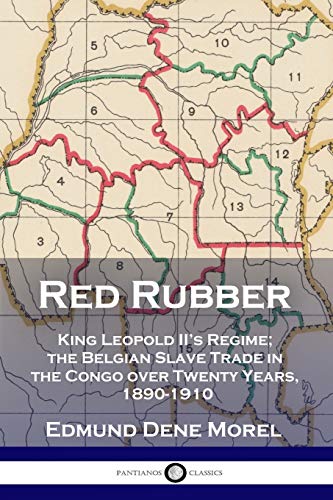

The Rubber Terror in the Congo
The international rubber boom of the late 19th century brought about one of the most ghastly forced-labor regimes of modern times. Industrializing countries suddenly found themselves with a voracious appetite for rubber, which was used to manufacture bicycle tires, electrical insulation, and thousands of other products. King Leopold quickly saw the value of rubber vines native to the Congo rainforest and pivoted from ivory to rubber as the colony’s cash crop. To enrich himself as quickly as possible, however, the king would have to force production on an industrial scale, through coercion, violence, and utter contempt for human life.

Leopold created the Force Publique (FP), a brutal colonial army tasked with enforcing rubber quotas. FP European officers led their African conscripted soldiers under the threat of death. Where villages failed to meet their rubber quotas or produced substandard rubber, the army took hostages, burned huts, and executed community leaders. Whipping, flogging, and mutilation were commonplace; so was the severing of hands as both punishment and to deter theft.
Cutting off hands became a system, with soldiers of the Force Publique even collecting severed hands as evidence that bullets had not been wasted. The FP’s presence was one of constant terror, which shaped a system of violence across the Congo.
The terror also extended well beyond violence. Rubber forced labor withdrew men from agriculture, hunting, community, and families, leading to famine. Communities would abandon their villages and flee deeper into the forest to escape colonial rubber taxes and conscription. The FP also relocated communities or forcibly pacified them to control labor more easily. The system destroyed traditional community structures, many of which had been organized to violently resist the FP’s pacification raids in the first place. In just two decades, the Congo’s social structures had begun to fall apart, family by family, clan by clan, village by village.

In total, historians and demographers estimate 10 million Congolese perished during Leopold’s 20-year rule; about half of the population. In addition to those executed or mutilated, far more died of starvation, disease, overwork, and the collateral damage of scorched-earth expeditions and depopulated homes. The actual number of victims will likely never be known, as any accurate census was a lost cause from the start. The demographic collapse remains one of the clearest ways to gauge the scale of the horror.
Missionary reports and letters, as well as the accounts of journalists and whistleblowers, would become critical in dismantling the Rubber Terror. George Washington Williams, E.D. Morel, Roger Casement, and European missionaries, as well as American Presbyterian and Methodist missionaries, began to expose the actual story.
From letters and memoirs to printed articles and even diplomatic cables, these voices detailed the burned villages, mass graves, brutalized children, and atrocities of King Leopold’s regime. The stories of what had been a private rubber monopoly would go public, setting off the world’s first human rights movement.
Atrocities Beyond the Congo
The Congo Free State represents the most egregious example of King Leopold’s violent system, but it is by no means the only one. The king invested his profits from rubber and ivory in business interests worldwide. He made speculative investments in Asia, the Middle East, and Latin America that often linked Belgium to extractive industries based on indentured labor or forced recruiting. Leopold II understood empire in terms of opportunity, and he used his fortune to buy his way into systems of exploitation everywhere he could, from railroad schemes in China to land concessions in Guatemala.
The Belgian colonial administration outside of the Congo also maintained structures of violence that King Leopold made normal. Belgian rule in Ruanda-Urundi, the name given to Rwanda and Burundi when they were both under Belgian control after World War I, replicated some of the most egregious features of Leopold’s system. The administration forced agricultural quotas, demanded unpaid labor, and restricted movement. Belgian officials formalized and expanded pre-existing social distinctions between Hutu and Tutsi by requiring identity cards that recorded ethnic identity and by reserving access to education and government jobs for Tutsi elites. This later contributed to the 1994 genocide—an indirect legacy of Belgian colonial rule based on conceptions of race developed in Congo.

Elsewhere in the world, Belgium also benefited from colonial trade systems based on coercion, like the indentured labor networks of Asia or mining operations based on dangerous and uncompensated workforces. In the Middle East, Belgian financiers were involved in resource extraction operations that displaced local communities and depleted the environment. The scale of structural and direct violence varied, but the system remained the same: profit based on the dispossession of others.
The Belgian colonial state, everywhere, entrenched structural violence in racial hierarchies. Race determined access to education, mobility, and legal rights. Indigenous peoples were denied political representation or subjected to cultural assimilation campaigns designed to undermine local languages, religions, and customs. The state frequently justified such policies as “modernization,” even as it continued to exploit them for profit in the same paternalistic rhetoric that King Leopold II had used to disguise his personal atrocity machine as a humanitarian enterprise.
But the violence did not end when King Leopold died in 1909. Even after Belgium took direct control of the Congo in 1908, the state maintained a system of forced labor under different guises. New economic priorities, such as cotton cultivation or mining for copper and uranium, still required large labor forces to collect and process resources for profit. These industries were central to Belgian wealth in the first half of the 20th century, and they depended on systems that pressured workers into dangerous or deadly labor conditions in exchange for minimal compensation. The uranium extracted from Congo’s Katanga Province in the 1950s, for example, would become central to the bombs dropped on Hiroshima and Nagasaki.
Taken as a whole, these global patterns demonstrate that the Congo Free State was not an aberration but an exemplar. King Leopold II built an extractive machine that Belgium took over and adapted, then tried to replicate and extend all over the world. It is only by viewing his global impact that we can understand the scope of his empire of cruelty: a system that left legacies not only in Central Africa but across the globe, and that continues to shape political, cultural, and economic histories in the present.
International Outrage and the Birth of Human Rights Movements
The full extent of King Leopold’s Congo would have remained hidden without a handful of courageous early whistleblowers who spoke out at significant risk to their lives. Missionaries like William Henry Sheppard provided the first accounts of severed hands, burned villages, and malnourished children, publishing their work upon returning home to stunned audiences.
E.D. Morel, a journalist working for a Liverpool shipping firm, noticed that ships heading to Congo carried only guns, not trade goods, from which he deduced that forced labor was paying for the colony, not commerce. Eyewitness statements from former Force Publique officers and the few Congolese laborers who managed to escape or were rescued supported their claims. Together, they formed the first wave of whistleblowers who penetrated Leopold’s wall of silence.
The British government lent a further hand when it sent diplomat Roger Casement to conduct a firsthand investigation. The resulting Casement Report (1904) included specific, verifiable accounts of killings, mutilations, forced labor, and kidnapping, filled with eyewitness interviews and exact locations and dates. One of the most comprehensive, empirically-based human rights reports of its day, its contents were reprinted in newspapers throughout Europe and the United States, generating public shock and outrage against King Leopold and his regime.

Outrage soon gave way to activism. E.D. Morel and Roger Casement founded the Congo Reform Association (CRA), which became the first modern international human rights movement. The CRA had branches in Europe and North America, held public lectures, and disseminated pamphlets on the atrocities in the Congo. They lobbied politicians, business leaders, and the public with detailed evidence, showing graphic photographs that audiences could not easily ignore. The campaign was unusually intense and sophisticated for the time, blending investigative journalism, public education, and political advocacy.

With mounting pressure from foreign governments and missionaries, who were supplying new evidence, the Belgian government was at last forced to act. Under sustained public and diplomatic pressure, and with his throne in Europe’s salons at risk, King Leopold II of Belgium was forced to surrender his private control of the Congo Free State in 1908. The Belgian government annexed the territory. It renamed the Belgian Congo—an imperfect reform, but a significant defeat for Leopold and a resounding victory for the world’s anti-atrocity campaigners.
In many ways, the Congo reform movement was a turning point in the history of human rights work. The CRA became a model for later humanitarian organizations, showing how evidence could capture global public attention and change policy in far-off places. The Congo also contributed to early conversations about international law and the responsibility of colonial powers to protect vulnerable populations from state violence and atrocities. It can be seen in the late-19th-century reinvigoration of anti-slavery movements, the post-World War II rise of global watchdog organizations, and the spread of human rights norms.
The Congo reform movement was one of the first successful examples of transnational activism, and arguably the first to successfully pressure a foreign government into policy reform. It did not end colonialism or Leopold’s other personal atrocities, but showed the world that mass atrocity could no longer be hidden and ignored, and that outraged public opinion could itself become a force for changing history.

King Leopold’s Stained Legacy
Memories of violent exploitation still linger in Congo, haunting us today as a reminder of our past and present failures to recognize and confront colonial legacies of inequality. King Leopold’s Congo reveals the violence and hypocrisy of imperial ideologies. Through the tools of forced labor, violent quotas, terror, and the Force Publique, Leopold turned the Congo into a massive extraction machine by which millions of Congolese people died, and millions more were reduced to broken survivors. His legacy as one of the cruelest and most exploitive monarchs in history is a stark example of the terror and violence that can be wreaked by those with unfettered power, disguised under the thin veil of humanitarianism.
Understanding this history is essential to understanding and undoing the long shadow of colonialism and the mechanisms by which it continues to drive massive inequality across the world. The example of King Leopold’s Congo should teach us all not to be blind to the violence of imperialist ventures or to repeat such horrors. It can also teach us how recording, testimony, and consistent pressure from multiple actors can be used to dismantle systems of violence, even those upheld by the might of a global empire. This legacy of whistleblowers, reformers, and committed activists set the stage for later global human rights movements and is a lesson and a light for activists today.
King Leopold’s personal rule over the Congo ended in 1908. However, his policies still haunt the Congo today, contributing to many of the country’s ongoing problems, such as political instability and exploitative extractive practices. The complex and violent legacy of Leopold II is a warning about the power of authoritarianism and the extreme consequences of unchecked rule by one, as well as a call to remember the power of collective resistance and activism. By keeping this past alive with clarity and honesty, we honor the legacy of those who suffered so terribly under this regime. We also reaffirm the importance of vigilance and global human rights protections wherever they are threatened.