(marcowenjones.substack.com)
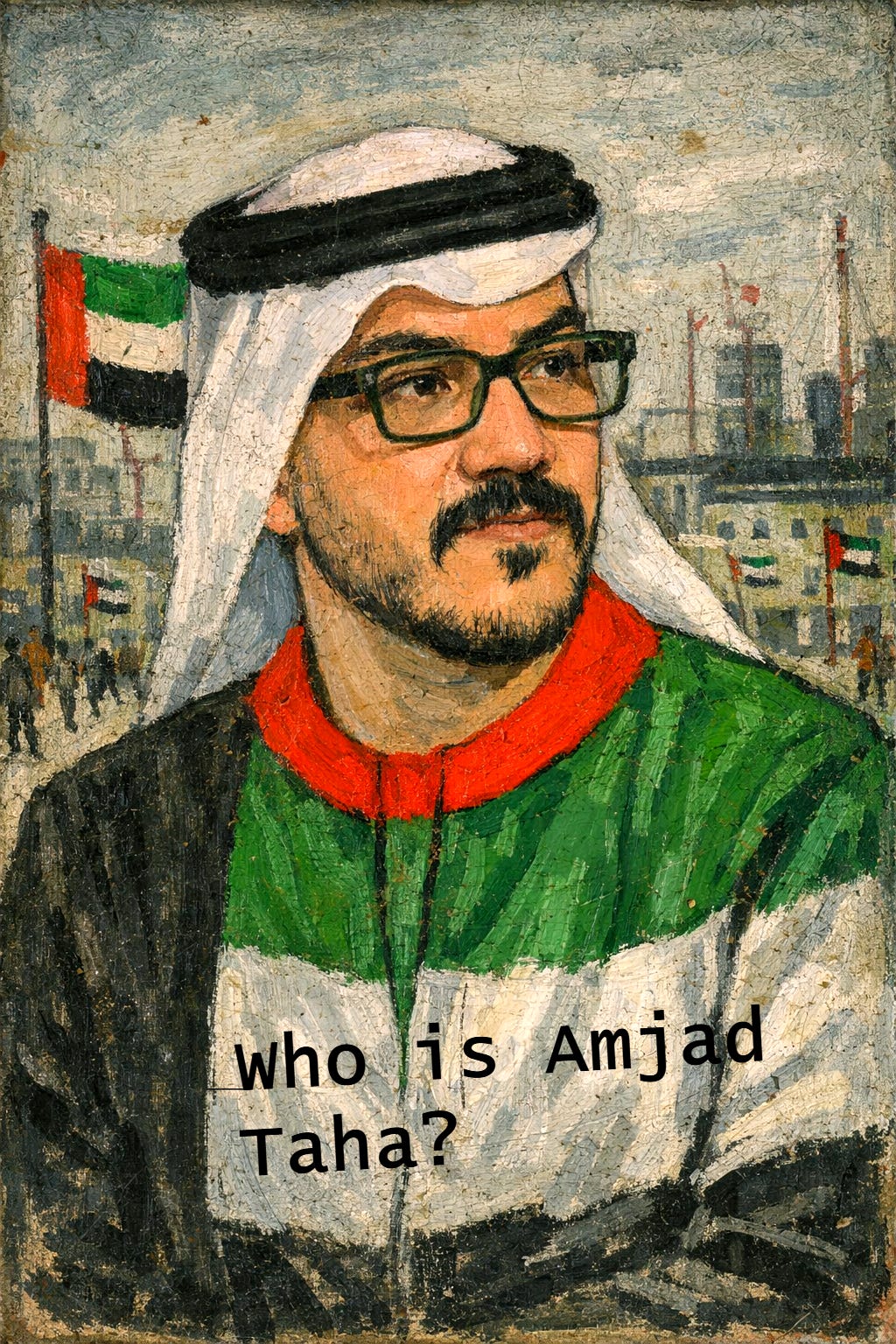
Amjad Taha is a disinfluencer, someone who repeatedly circulates false and harmful information. Yet despite a long and well-documented record of fabrications and conspiracy theories, he continues to be platformed by major Western media outlets, think tanks, and even parliamentary bodies.
But who is he?
Amjad Taha presents himself as an ‘Emirati Expert in Strategic and Political Affairs’. He has a large X following (>600k on X and >880k on Instagram) and appears in English language media outlets in the West with increasing regularity. In sympathetic profiles and TV hits he is introduced as a counter-extremism expert, author and a voice of Arab–Israeli normalization.
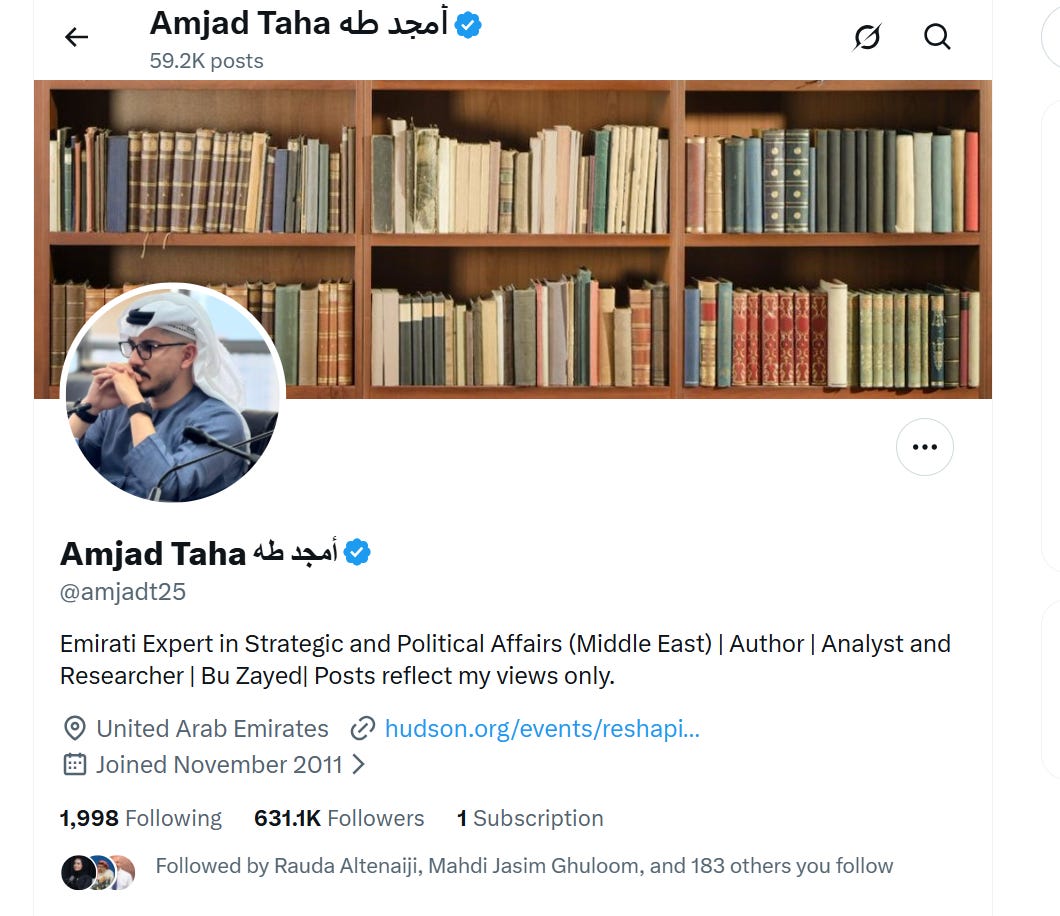
He has appeared in/on GB News, Sky News, CNN and the Daily Mail. He’s even been on the BBC. Recently, he wrote an op-ed on LBC Opinion about the danger of the wrong type of Muslims being allowed into Europe. Earlier this year he co-wrote an article published on the conservative Hudson Institute; he has been retweeted multiple times by Elon Musk (among others) and was somewhat inexplicably invited to talk to the Canadian Subcommittee on Human Rights about the UAE’s role in Sudan.
Yet when you follow the trail of his greatest hits, and dig into his past, it is remarkable how consistently Taha has been serving up anti-emancipatory or counter revolutionary talking points benefiting the UAE, Bahrain, Israel (he is even listed as trusted source by Hillel), and, more recently, the European right-wing/far right . He is part of a new darling of some western media outlets, the Arab or Muslim-presenting pundit warning about bad Arabs and Muslims.
What’s perhaps more striking though, is how he gets platformed despite his long record of spreading demonstrably false claims.
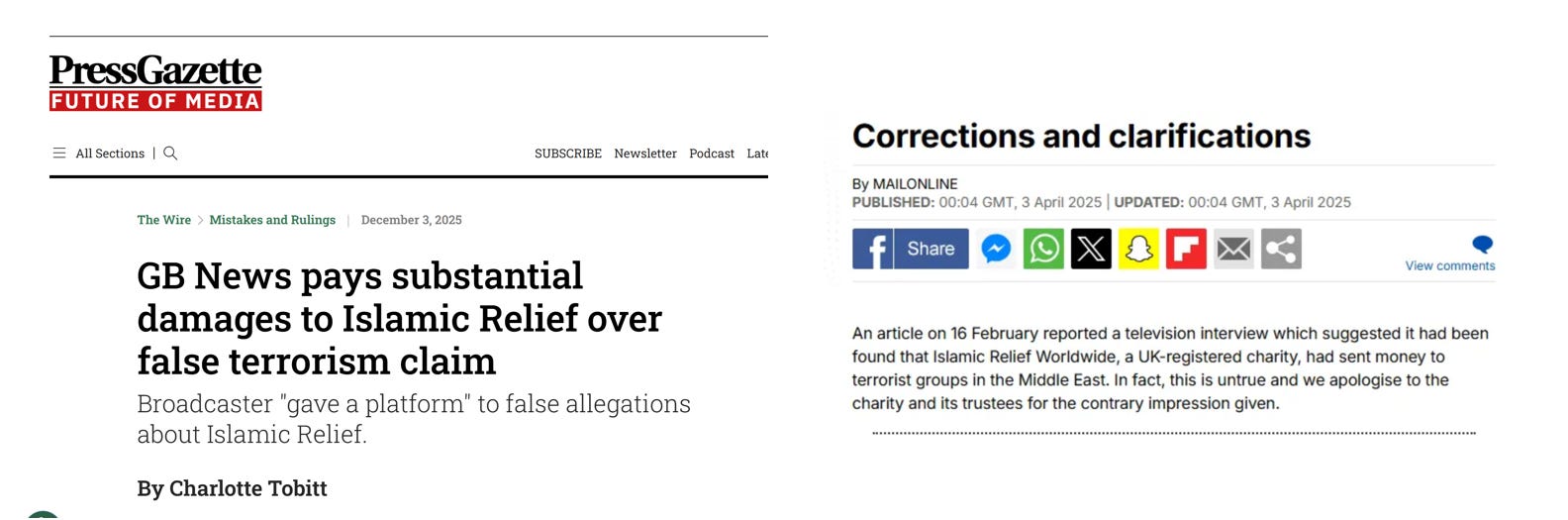
Most recently, Taha’s interview with Camilla Tominey on GB News resulted in the channel being sued by the charity Islamic Relief. The headline says it all ‘GB News pays substantial damages to Islamic Relief over false terrorism claim: Broadcaster “gave a platform” to false allegations about Islamic Relief”. The person they platformed and who made the comments was Taha. The British right-wing paper the Daily Mail also issued an apology and correction after publishing an article based on Taha’s GB News segment.
Part disinfluencer, part provocateur, Taha has gone from activist to journalist, to think tank director, to analyst, to mini-media mogul (more on that in a separate post). But ultimately, he seems to be someone who is extremely useful in saying what certain people want other people to hear - especially when it comes to the threats posed by political Islam, and immigration to Europe.
Taha’s trajectory also reflects a media ecosystem that elevates voices aligned with security-led narratives on Islam, the Arab Spring, and Palestine, even when their claims lack credibility.
Amjad’s Early Days: 2011 and the Bahrain Uprising
But who is Taha and when did he rise to prominence?
According to the UK electoral register, Taha appears to have spent much of his youth in Birmingham in England. While often described as a British-Bahraini activist, there’s no clear evidence he actually has Bahraini citizenship. Public Companies House documents list his nationality as British. He occasionally makes reference to having been in Birmingham and the UK, although now he seems to emphasise that he is Emirati (his X bio states this).
Taha started out briefly as an Ahwaz human rights activist, before seemingly becoming some sort of anti-Bahraini opposition gotcha journalist. This article, which refers to him as ‘Amjad Taha Yassin’, describes him as the administrator of an Ahwazi Revolution news page on Facebook. In the interview Taha mentions how the plan was for Ahwazis in Iran to go up to the roofs to chant “Allah Akbar” (God is Great). Around the same time, Taha was also reported to have been part of the Ahwazi Organization for the Defence of Human Rights and the European Ahwazi Organization.
What was odd about Taha, especially to observers of Bahrain’s Uprising, was Taha’s transition into an anti-Bahrain opposition activist. In the wake of the Bahrain Uprising, his Ahwaz activism quickly morphed into him being a pro-Bahraini government provocateur.
In July 2011, Amjad participated in what were described as anti-Iranian demonstrations outside the Iranian embassy in London. Akhbar Al Khaleej reported that Taha was actually part of the protest organizing committee. The protest was ostensibly about Iranian interference in the Gulf states and Iran’s treatment of people in the Ahwaz region of Iran.
It is somewhat incongruous then that protesters reportedly called for the arrest of Bahraini opposition member Saeed al Shahabi (who lives in London). It is worth noting that Saeed Shehabi was exiled by the Bahraini government for his activism, and is still an alleged target of Bahraini government repression.
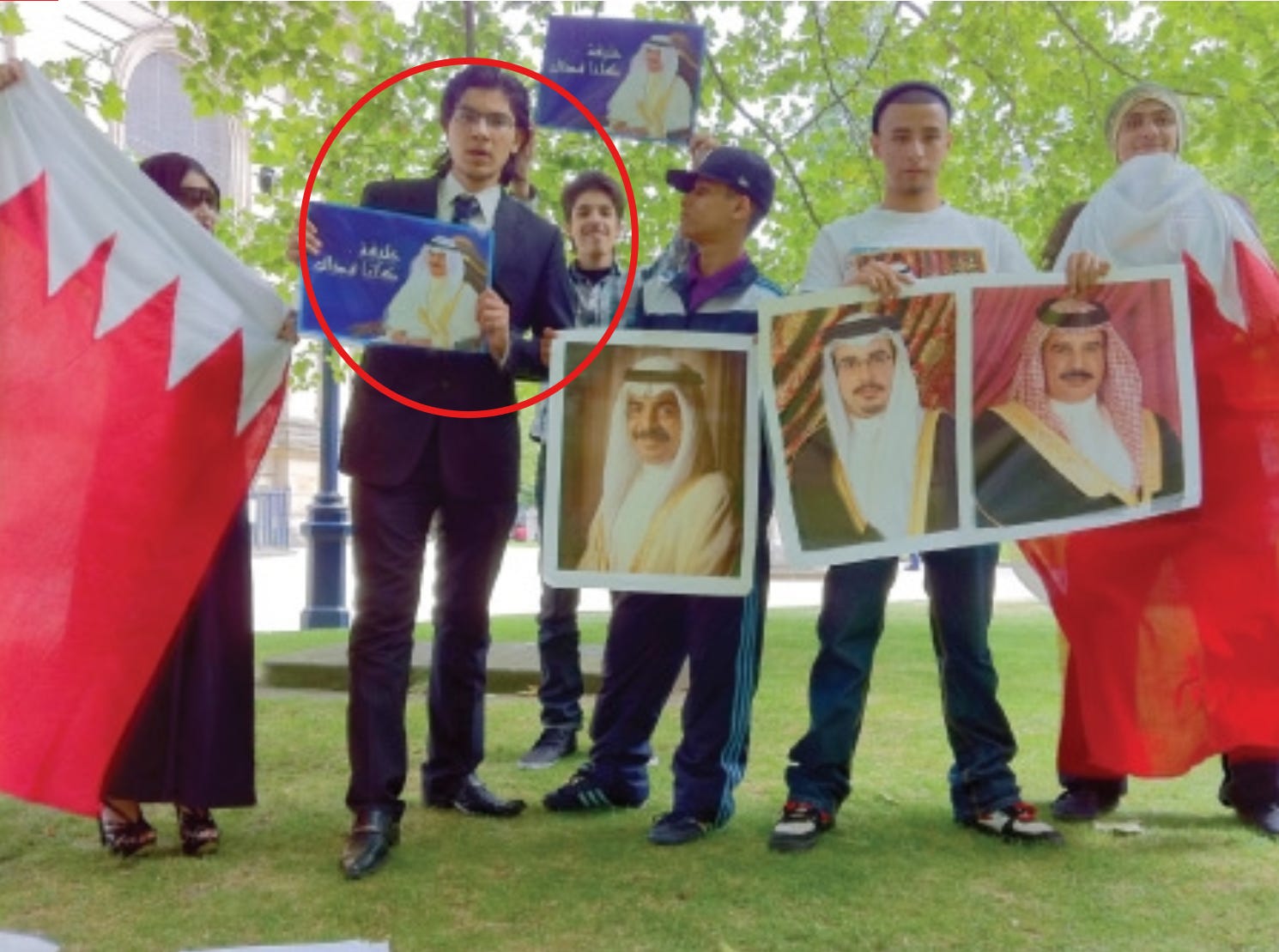
Perhaps more tellingly, ahead of the aforementioned protest in 2011, Al Bilad newspaper published an article with a photo of a young Amjad Taha with a group of other protesters holding up pictures of members of the Bahraini ruling family. Taha is holding up a poster praising Bahrain’s King Hamad.
A few months later, Taha was reportedly in the Middle East again, this time in Al Waleed refugee camp in Iraq, where there were Ahwazi refugees.
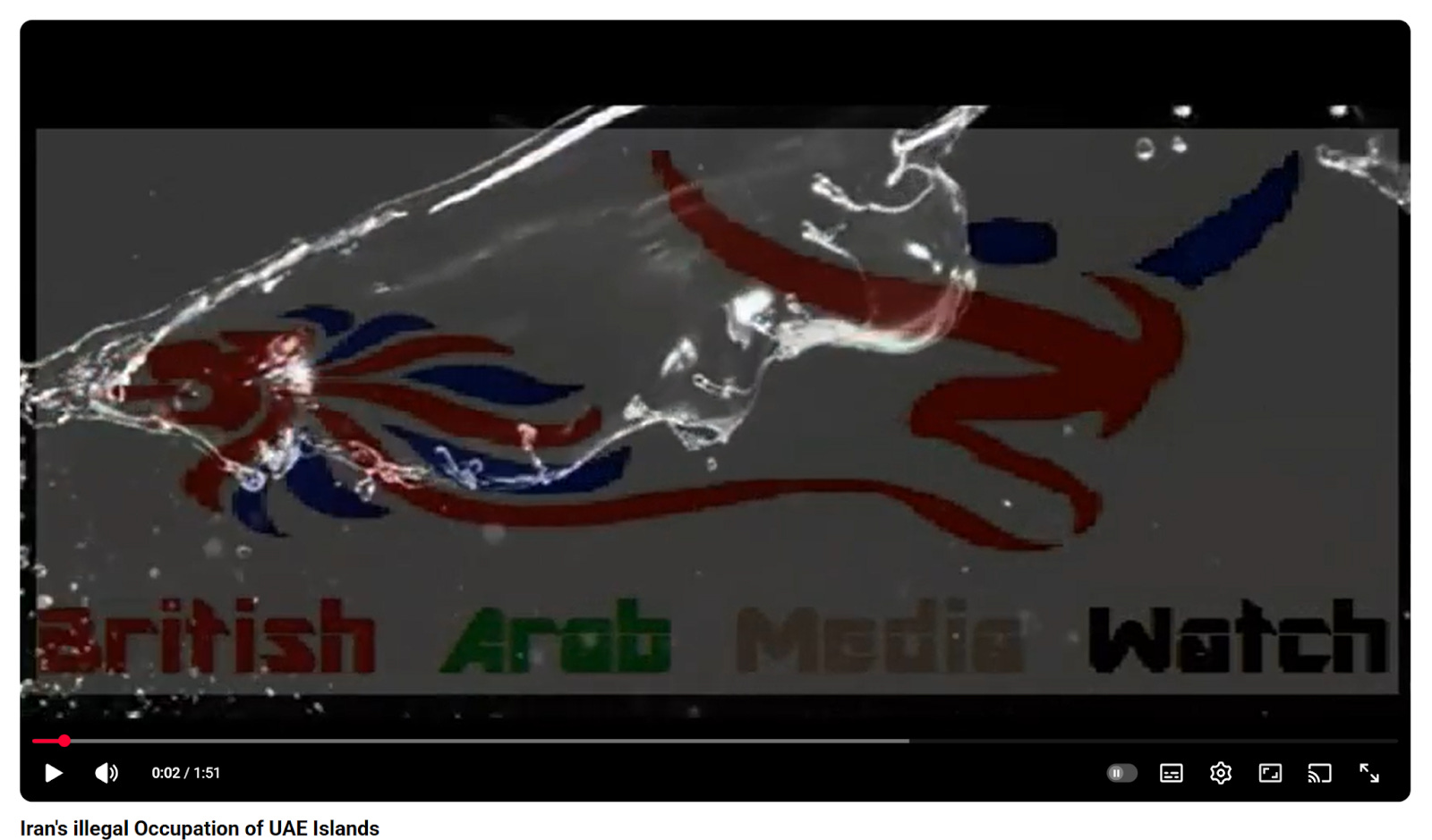
Taha’s list of affiliated organizations kept growing. At around the same time, he was being described as a spokesperson for ‘British Arab Media Watch’, an organization that never seemed to have existed - at least formally. The name did appear in shockingly amateur graphics in a video about “Iran’s illegal occupation of ‘UAE islands’”.
Some Bahrain’s sources actually describe Taha as working for the Bahraini Embassy in London. Whether that’s true or not is unclear, but he certainly did his bit trying to sabotage Bahraini opposition events in Europe. In interviews, like this one from 2012, Taha is doing blatant pro-Bahrain government propaganda (demonising Shia). He says things like how Shia protesters hate anyone who is not Shia.
2011-2012: Taha’s Pro-Regime Troll/Journalist Era
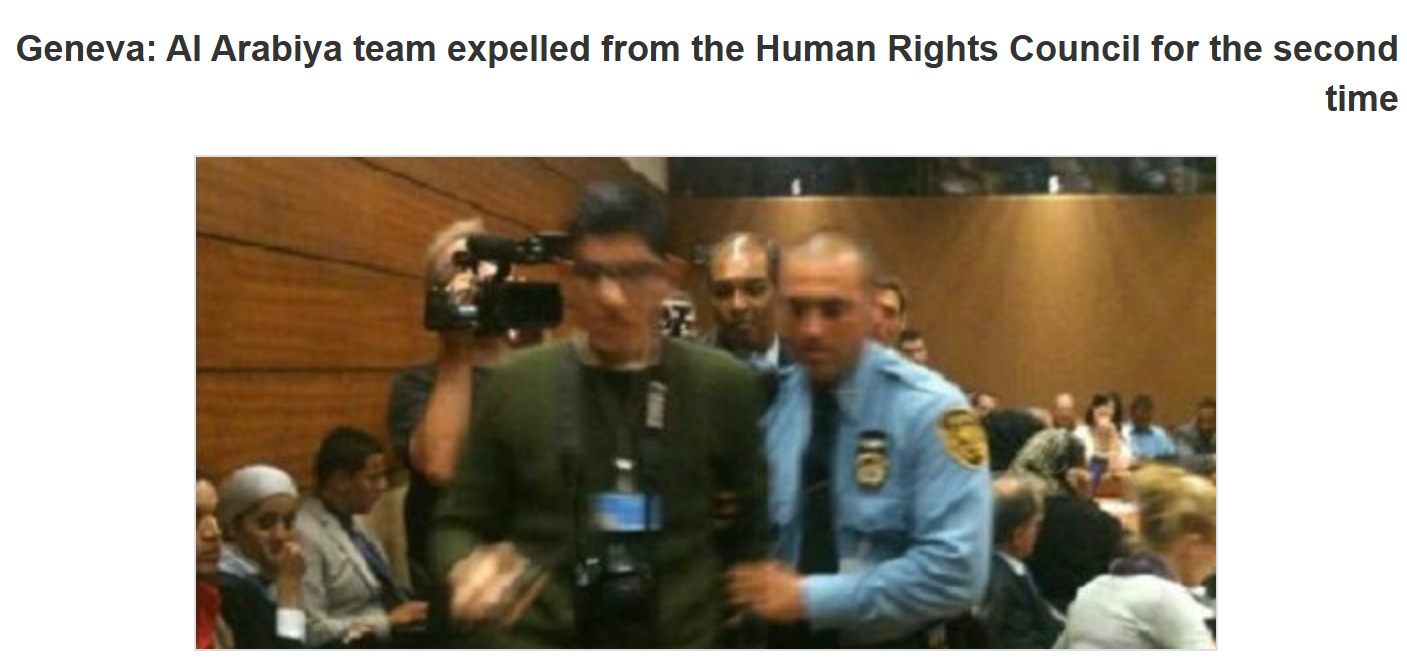
Amjad’s activities seemed to evolve from protests in the UK to trolling Bahrain opposition activists attending international human rights fora, where he is often described as a journalist. Here is a video from September 2012 of Taha disrupting a session in Geneva to say that a member of the Gulf opposition had met Mahmoud Ahmidenijad, the sixth president of Iran. He is then restrained by security. The Bahraini Mirror reported that Taha was kicked out of sessions in Geneva twice for his behaviour. Indeed, there are images of him being escorted out by security.
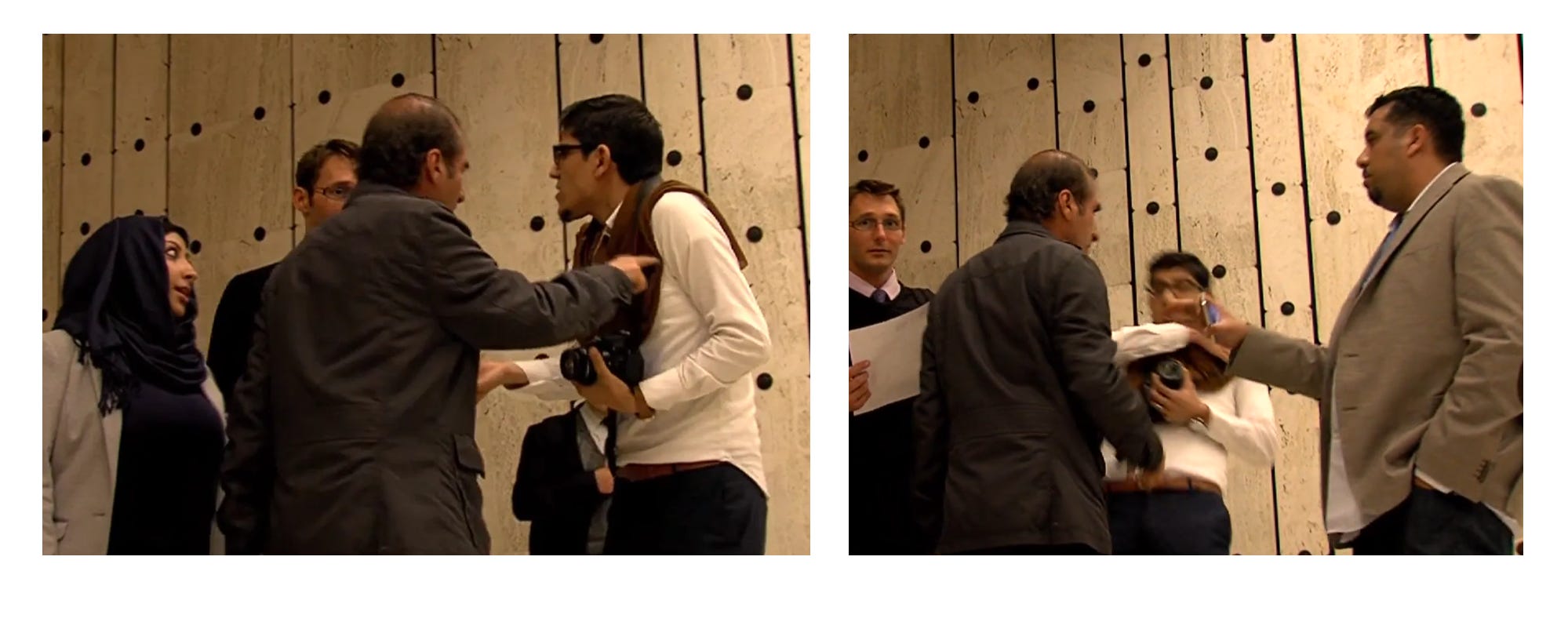
In addition to disrupting sessions he would post gotcha videos trying to frame the opposition as violent (and himself as a victim). In this particularly amusing example titled ‘Bahraini delegation assaults journalist Amjad Taha’, Taha falls back dramatically after being touched by a single finger.
In a report about the various episodes in Geneva, the pro-government Al Ayyam newspaper described Amjad Taha as an ‘Egyptian’ journalist living in London (It is not clear why).
This wasn’t the first ‘assault’ on Amjad. He was reportedly and allegedly attacked by members of the Bahrain Freedom Movement on a bus in Dudley in Birmingham in the summer of 2012. The pro-government newspaper Alayyam reported that people chanted anti-Bahrain government slogans and threw a baseball bat at the window, and that Amjad called the police. It’s not clear if any of this is true
In 2014, there was a better documented incident in Bahrain where Reporters Without Borders (RSF) backed Amjad and Al Arabiya’s Bahrain correspondent Mohammed Al-Arab. RSF condemned an attack on Mohammed al Arab of Alarabiya by fringe members of a protest group, and his ‘cameraman’ Amjad Taha. Even Al-Arab acknowledged most of the protest was peaceful, so it is unclear why Al-Arab and Taha were engaged with this other group, or who the group actually were. (It is worth noting the pro-government media were doing their utmost to portray the Uprising as violent to justify their violent repression). So at least in this case, and a few others, it is indicated that Amjad Taha worked for Al Arabiya. Some of the online responses to this incident prompted Taha to attempt to sue some of his critics online for libel (ironic really).
Narrative Laundering: The US Ambassador Controversy
In 2013, Taha was now being reported as being the head of the London office of the Gulf International Organization for Human Rights - a rather opaque and ephemeral outfit (and likely GONGO) reportedly set up by Issa Rashed al-Arabi.
In the same year Amjad Taha published an article on the unmoderated public platform but CNN-branded ‘CNN iReport’. Despite this, several pro-government media outlets, including Al Bilad, republished it as verified news coming from the real CNN. The fabricated piece falsely claimed that former U.S. Joint Chiefs of Staff Chairman Hugh Shelton had accused Washington of destabilising Bahrain during the 2011 uprising, and that the then U.S. Ambassador to Bahrain Thomas Krajeski intervened to pressure Shelton into withdrawing those remarks.
Taha’s use of Krajeski appeared deliberate. At the time, the ambassador was seen by Bahraini hardliners as too close to civil society and reform advocates. By portraying him not as a critic but as a key conspirator in suppressing the alleged “truth,” he became a secret architect of a geopolitical plot. The Bahraini Mirror published an article highlighting Taha’s propagandistic piece.
The whole episode demonstrated an interesting example of narrative laundering, seeding a piece of unsubstantiated information in a vehicle like iCNN to give the illusion of credibility, to then have it picked up by other outfits.
This ‘laundering’ modus operandi would become increasingly common for Taha.
Credential Laundering: Amjad Fazeli and The British Center for Middle East Studies Era, 2013 - 2020(ish)
At the centre of Taha’s personal myth-making is (or rather was) the awkwardly named “British Center for Middle East Studies and Research,” (BCMSR) of which he [was] the director - and seemingly soul member. In actuality, BCMSR displayed characteristics commonly associated with front organisations for narrative laundering.
Front organisations are nominal institutions, often little more than websites, dormant company registrations, or one-person “centres”, that exist primarily to manufacture the appearance of expertise or consensus. Through credential laundering, media outlets repeat the titles and affiliations attached to these entities without verification, allowing authority to accumulate through citation rather than substance.
Narrative laundering operates alongside this process: unsubstantiated claims are seeded in low-credibility or lightly moderated spaces and later recirculated by secondary outlets as if independently validated. Together, these practices enable politically useful narratives to move into mainstream discourse while obscuring their origins and diluting accountability when those claims prove false.
Multiple media outlets have repeated Taha’s BCMSR title as if it were a real think tank. Some outlets dug a little deeper. The Athletic’s investigation into World Cup disinformation found that it didn’t exist:
“Taha, with over 400,000 followers, claims to be a “strategic political affairs expert” and “regional head of the British Center for Middle East Studies and Research”. But The Athletic can reveal — even after speaking to the man himself — that there is no evidence of this organisation existing”
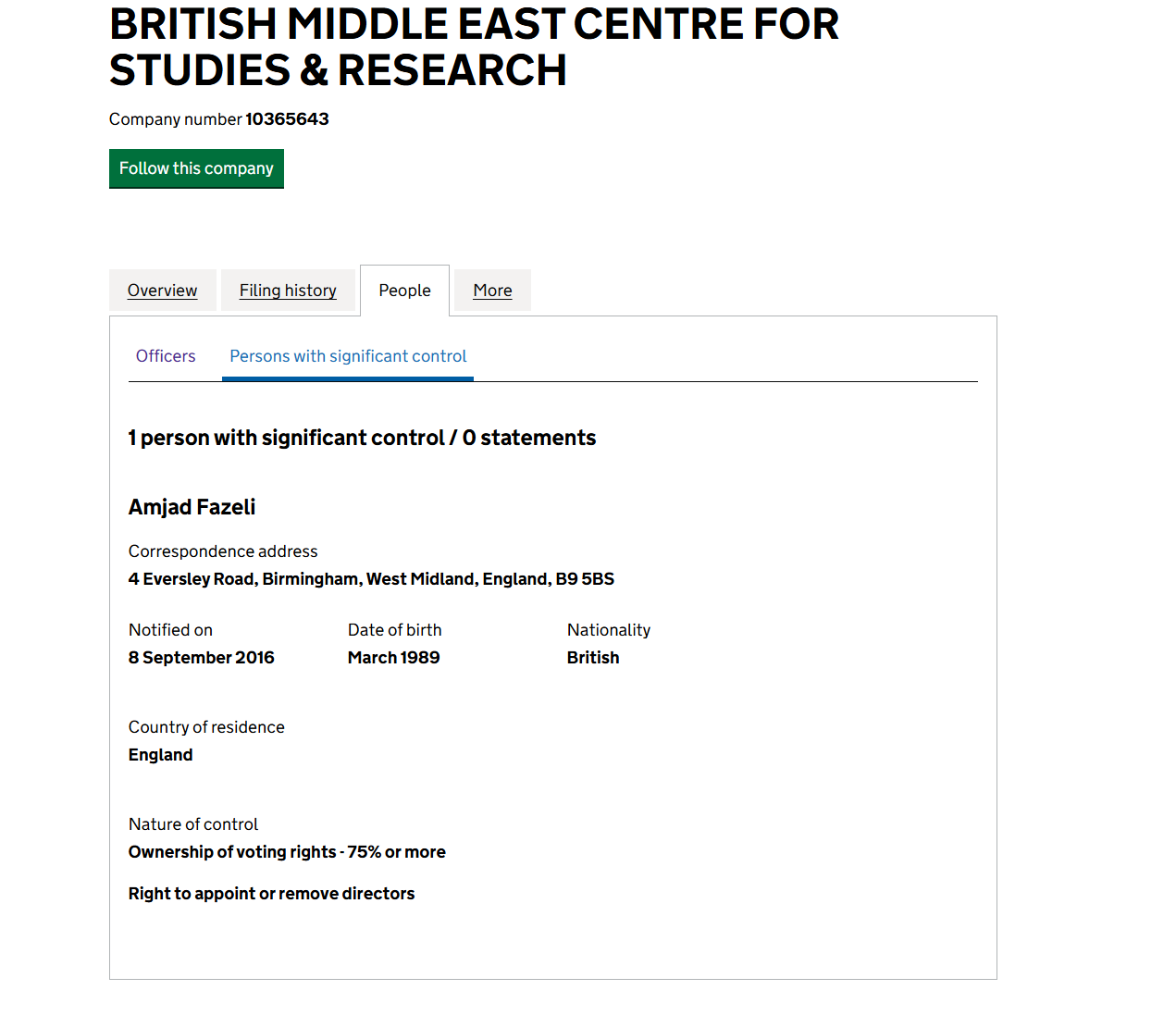
But it seems that it did exist though, at least extremely briefly in legal form, and not how Taha had portrayed it. There is a record on Companies House of the ‘British Center for Middle East studies and Research’, set up from a Birmingham address in 2016 by a man with British nationality called Amjad Fazeli. Fazeli was the sole officer of the company. BCMSR was dissolved in 2018 after a compulsory strike off (usually this means the company hasn’t filed required documents, e.g. accounts, annual confirmation statements, there’s no evidence it is trading, or the owners aren’t responding to Companies House).
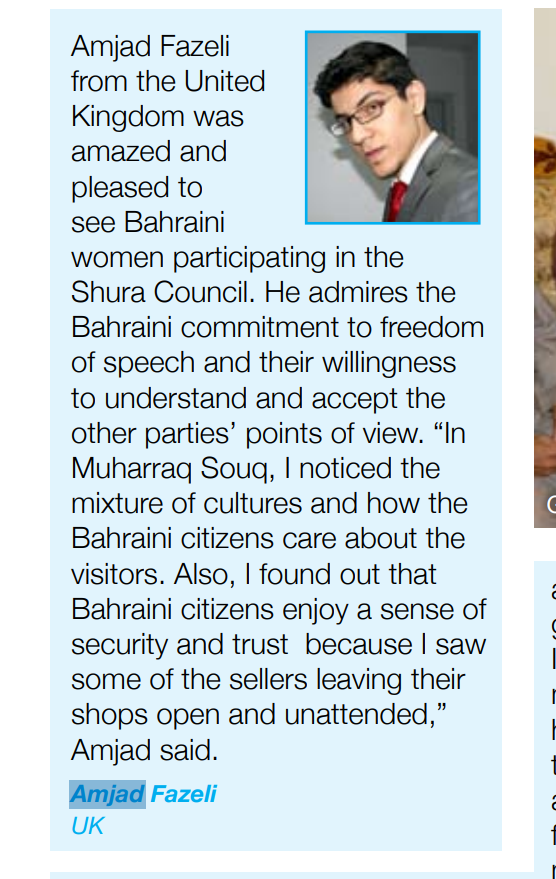
There is another publicly available photo of young Amjad Taha, who is also described as Amjad Fazeli. He was part of a delegation to Bahrain in 2012 organized by the“Good Word Society”. He left a glowing appraisal of Bahrain, which he also talks about in this interview on MessageTV. (It is not clear why or when exactly Amjad dropped the Fazeli name).
The lifespan of BMCSR is unclear. The archive of BMCSR’s website says it was founded in London in 2008 although the oldest archived page of the website goes back to May 2013, and the Twitter link on the website actually goes to Amjad’s personal X account - amjadt25. Its Twitter account was set up in 2015, and BMCSR’s last tweet was in 2019, and its website no longer works, although it was still posting content in 2021. It appears to have gone down in 2022.
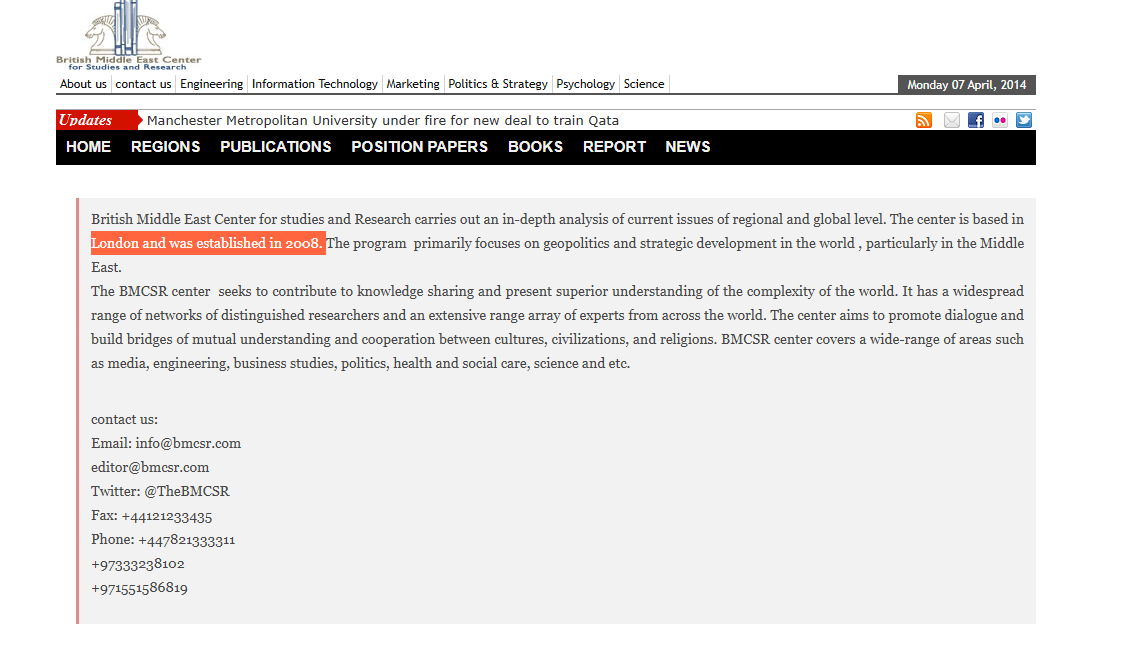
Interestingly, Taha had told the Athletic that BCMSR was based in Chelsea, an affluent district in west London, and said it involves many “top experts” other than himself”. The absence of any institutional footprint – beyond media introductions, a website and Taha’s own bios – strongly suggests the “Centre” was, at best, a website used to launder authority via a digital media presence and a short-lived and neglected company registration. It is not clear who the ‘top experts’ were either, with the exception of a relative of Taha’s who appeared to have been a content writer for the website. Somewhat bizarrely, another person with the same surname as Amjad even uploaded a BCMSR-branded pdf of various gps-bicycle designs. All in all, the whole thing seemed very amateurish.
Taha himself does not appear to have a phd or advanced degree, a common and often expected qualification for someone in a think tank or research centre. His qualifications on old bios are listed as a BA in Journalism, Media and Cultural Studies , BA (Hons) from Middlesex University. His poorly-written book biography also describes him as some sort of crossover journalist at Al Arabiya and Bayan in the UAE, where he was both a journalist and ‘social media executive’ specialising in ‘SEO digital marketing’.
As of December 2025, Taha has dropped the BCMSR title from his X bio, which now reads ‘Emirati Expert in Strategic and Political Affairs (Middle East) | Author | Analyst and Researcher’. (It is worth noting that Taha now describes himself as Emirati, and not British, or indeed, Bahraini).
The Gulf Crisis 2017: Taha’s Conspiracy Era and Thobe Era
Following the blockade of Qatar by UAE, Saudi Arabia, Bahrain and Egypt in 2017 Taha became a fervent critic of Qatar. There are countless interviews by Taha, and his tweeting generally reflected his adoption of pro-Saudi and pro-UAE positions. In the Emirates he even shifted attire, adopting the traditional thobe - perhaps for added authenticity.
It was here that some of his most well known, and perhaps most absurd pieces of disinformation, surfaced.
After Emirati dissident Alaa al-Siddiq was killed in a car accident in the UK in 2021, Taha used the tragedy to push a conspiracy theory: he claimed Qatari Muslim Brotherhood intelligence had assassinated her, allegedly because of a “black file” of secrets. None of these claims were substantiated. They did, however, earn Taha attention and virality.
In 2020 he was a key node spreading rumours that there had been a coup d’etat in Qatar.
Taha’s most globally visible intervention came ahead of the 2022 World Cup in Qatar, when he claimed an “Exclusive” – that Qatar had bribed eight Ecuadorian players $7.4 million to lose the opening game.
The tweet went viral, was picked up by news sites and influencers, and helped cement an early narrative that the tournament was being fixed in real time. Incidentally, Qatar lost the game.
At the time, I had stated in no uncertain terms that anything revelatory coming from Taha was almost certainly false, and designed as some sort of information operation. (I analysed his tweet, which was also promoted by bots.)
In the Athletic’s subsequent investigation, it was found “he could provide no proof ...that the evidence behind the viral claim about Qatari bribery has been seen by anyone other than him”. He also accused the Athletic journalists of being Qatari stooges.
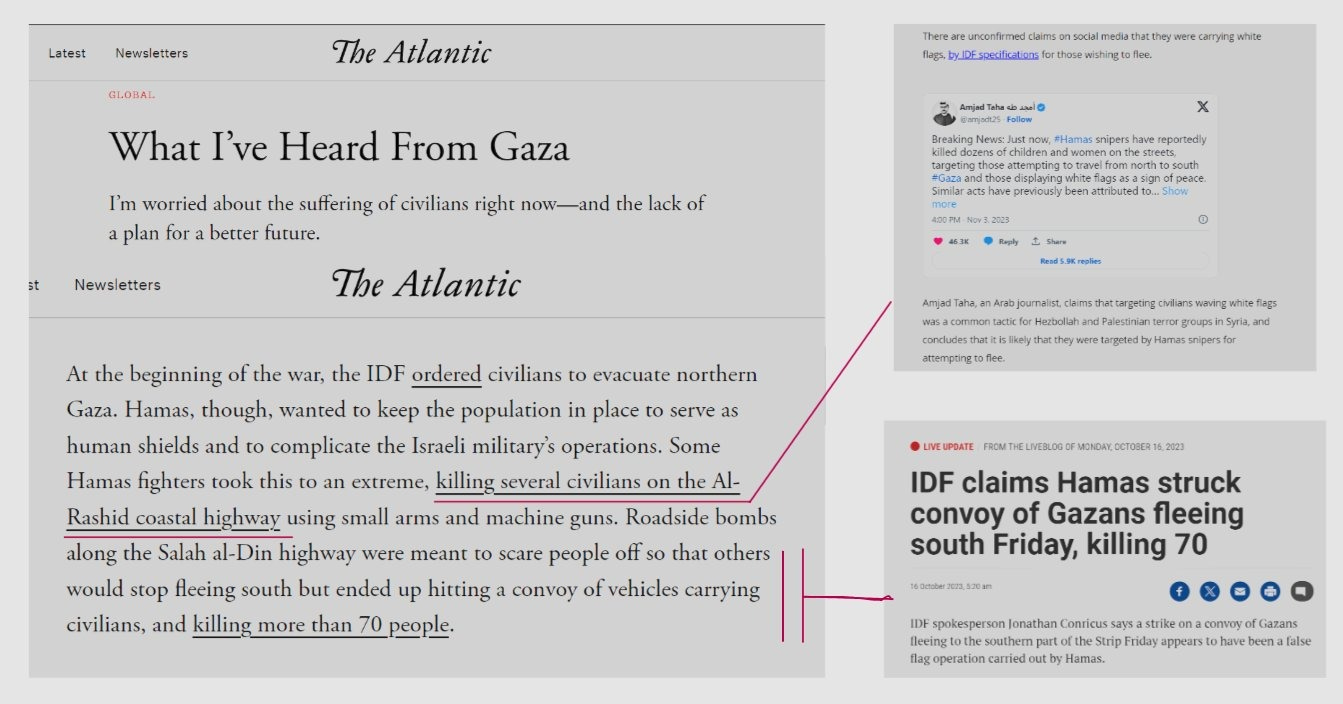
Since October 2023, Taha has pushed unverified atrocity narratives from Gaza. Among them are unsubstantiated claims that Hamas snipers “reportedly killed dozens” of Palestinian civilians on the coastal al-Rasheed road as they tried to flee south – a narrative picked up by outlets such as the New York Post and one that eventually found its way into the pages of the Atlantic in this piece by Ahmed Fouad Al Khatib.
Taha has made false claims about coup d’etats in Qatar, and generally has a large influence on hashtags concerning issues related to Iran and Islamism.
Abraham Accords and Taha’s Iran/Islamist Obsession
Following the 2020 Abraham Accords, Taha engaged in high-profile visits to Israel, meeting state officials, influencers, and public diplomacy actors. Amjad Taha is a vocal advocate of Arab–Israel normalization and a prominent figure in Israel’s public diplomacy targeting Arab audiences. He is also reportedly a co-founder of the Sharaka Institute, an organization dedicated to advancing normalization with Israel among Arab states (Although Taha is not listed on the website).
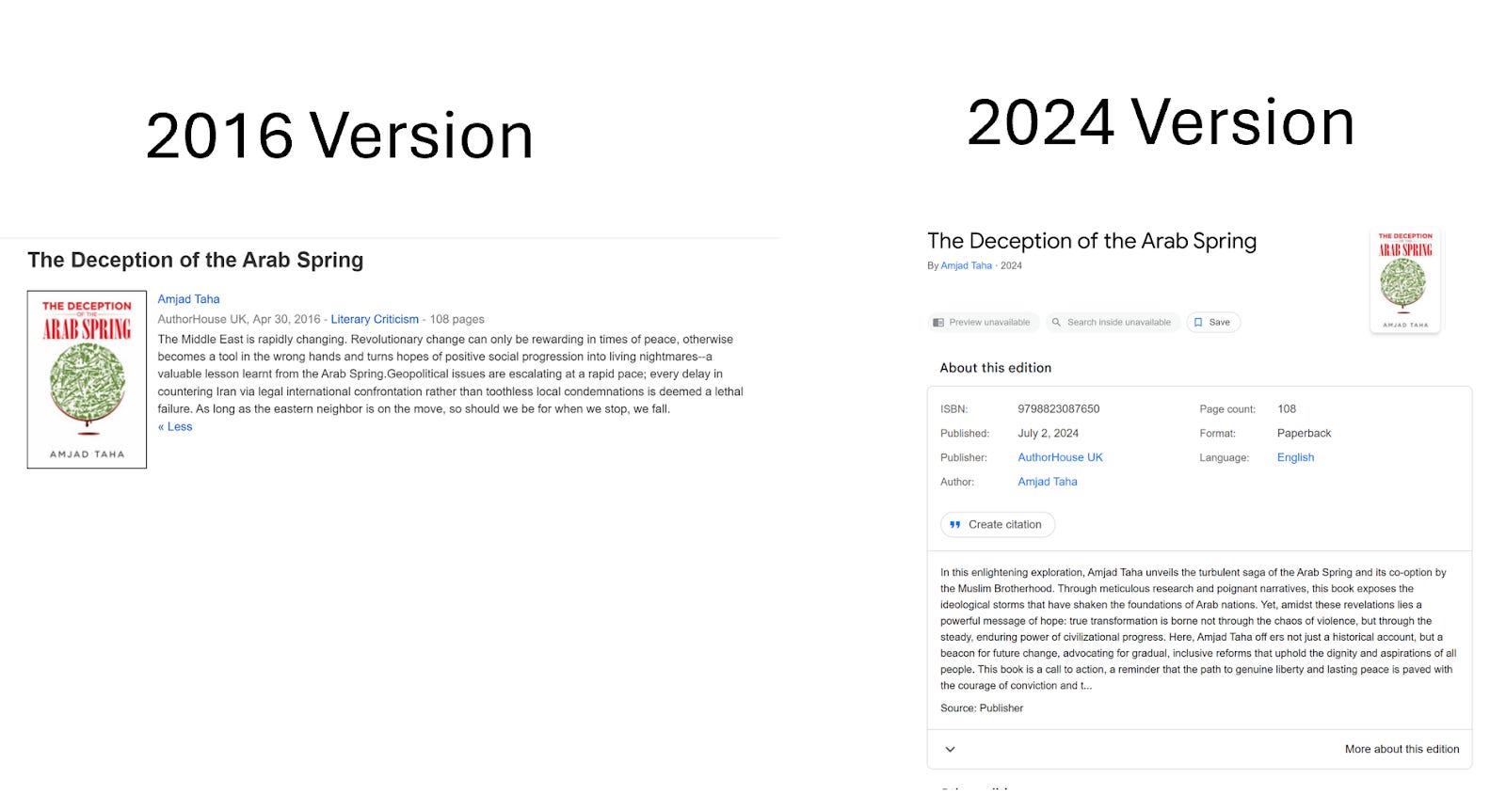
His book, The Deception of the Arab Spring, published by AuthorHouse in 2016, is, according to a ‘review’ in the Athletic, ‘very short and… riddled with countless basic spelling and grammatical errors.” But there are two editions. The original edition, published in 2016, revolved around the argument that Iran was behind the Bahrain Uprising and Arab Spring writ large. The updated version, published in 2024, which has an identical name and cover, is about how the Muslim Brotherhood is the most evil force behind the Arab Spring, and sounds much more GPT polished.
Talk about memory holing, which, according to Orwell, is the act of deliberately erasing, altering, or suppressing records (like documents, photos, websites, or books) to make it seem like they never existed. Taha’s book appears to dynamically adapt to whichever bogeyman zeitgeist of whichever Gulf government he seems to be defending at the time. First Bahrain, and thus Iran, now the UAE, and thus political Islam/the Muslim Brotherhood.
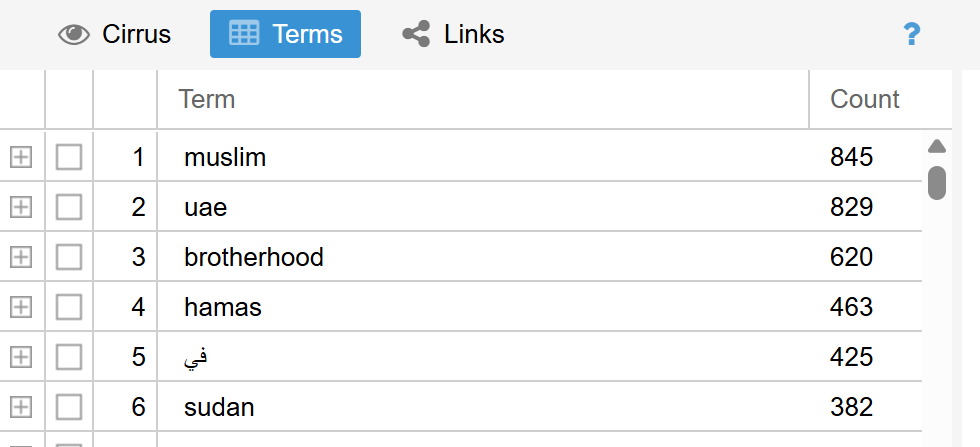
Over the past year(s) Taha has tended to focus on political Islam and the Muslim Brotherhood. An analysis of all his tweets from December 2024 to 3 Dec 2025 shows this quite starkly. ‘Brotherhood’ is his third most utilised term, after ‘Muslim’ and ‘UAE’. He’s also entering a Sudan era, and seems to be chummy with the anti-Muslim pseudo news outlet Visegrad24 (more to come on this), and has given interviews with Stefan Tomson, the outlets founder.
A News Outlet Finally Pays a Price for Hosting Taha
The most concrete recent blow to Taha’s credibility came via the UK courts. On 16 February 2025, he appeared on GB News’ Camilla Tominey Show and alleged that Islamic Relief Worldwide, a major UK-based humanitarian charity, had been banned overseas because investigations showed it had sent money to terrorist groups and formed part of an extremist agenda. In September 2025, Tominey published a to-camera correction.
Islamic Relief also sued. In December 2025, GB News issued a full apology agreed to pay “substantial damages and costs,” with a statement in open court confirming that the allegations were “completely untrue.” Taha’s words had been serious enough – and baseless enough – that a UK broadcaster judged it safer to pay out and apologise.
Taha has tried to style it out by claiming that his comments weren’t found to be false, and that the issue was Tominey failed to ‘challenge’ his comments. The court ruling is quite clear though.

What Taha said was untrue.
So who is Amjad
Taken together, these episodes make it reasonable to describe Taha as a chameleon-like figure in the information space — one who repeatedly adapts his identity, affiliations, and narratives to align with shifting political priorities and platform incentives, while maintaining an appearance of expertise and authority. Crucially, he has shown little apparent regard for accuracy or the collateral damage inflicted on individuals, charities, or entire states.
From a pro-Bahraini government provocateur, to a voice painting political Islam as the eminence grise behind seemingly every ill, Taha’s spiel feeds into a narrative of securitising Palestinians, Muslims and Arabs. It’s a synergy of UAE-aligned propaganda on political islam, and European far right and Israeli propaganda designed to provoke fear of Muslims in Europe to position Israel as a bulwark protecting Western civilization from Eastern barbarism while exporting UAE’s anxieties about the Muslim Brotherhood.
His media appearances outside the UAE, at well-established think tanks and news outlets, may indicate a PR effort to platform Taha, but it also may be a result of a political ecosystem where far-right narratives on Arab/Muslim immigration are being increasingly indulged by Western media. And who better to give this message than an Arab Muslim presenting individual (Taha always wears his Emirati thobe these days), who can be platformed by those institutions without them having to worry about accusations of racism.